


Page 136 - Crisis Communication Practical PR Strategies
P. 136
Challenges for the International Food Sector 117
                                                                             7
                                                                            1
                                                                           1
                 media began searching for any information on their own,
                 through their own sources, recording on-the-spot the images of
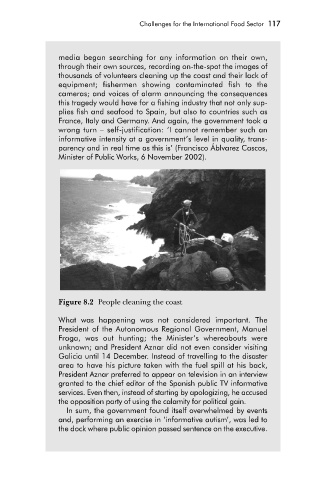
                 thousands of volunteers cleaning up the coast and their lack of
                 equipment; fishermen showing contaminated fish to the
                 cameras; and voices of alarm announcing the consequences
                 this tragedy would have for a fishing industry that not only sup-
                 plies fish and seafood to Spain, but also to countries such as
                 France, Italy and Germany. And again, the government took a
                 wrong turn – self-justification: ‘I cannot remember such an
                 informative intensity at a government’s level in quality, trans-
                 parency and in real time as this is’ (Francisco Áblvarez Cascos,
                 Minister of Public Works, 6 November 2002).


                 Figure 8.2 People cleaning the coast

                 What was happening was not considered important. The
                 President of the Autonomous Regional Government, Manuel
                 Fraga, was out hunting; the Minister’s whereabouts were
                 unknown; and President Aznar did not even consider visiting
                 Galicia until 14 December. Instead of travelling to the disaster
                 area to have his picture taken with the fuel spill at his back,
                 President Aznar preferred to appear on television in an interview
                 granted to the chief editor of the Spanish public TV informative
                 services. Even then, instead of starting by apologizing, he accused
                 the opposition party of using the calamity for political gain.
                   In sum, the government found itself overwhelmed by events
                 and, performing an exercise in ‘informative autism’, was led to
                 the dock where public opinion passed sentence on the executive.

