


Page 229 - Cultural Competence in Health Education
P. 229
Aging and Health Education   207


                       populations by using the Core Curriculum in Ethnogeriatrics, a model developed in
                       1999 and 2000 by the Collaborative on Ethnogeriatric Education. The collaborative
                       has noted that there are flaws and limitations in the U.S. Census data that affect our

                       ability to learn about cultural and demographic groups (Yeo, 2000).
                           Demographic data and ethnic and cultural perspectives affect the educational
                       community programs developed to meet the needs of our growing population of older
                       adults. Acknowledging ethnogerontological educational resources may provide the
                       context for better collaborative efforts among aging populations and health education
                       practitioners and thus better learning outcomes.
                            A study in rural Florida, where 772 physicians were surveyed regarding their
                       opinion toward the aging population, found that even physicians showed ageist per-
                       ceptions, especially toward people 85 years of age and older and those living in nurs-
                       ing homes (Gunderson, Tomkowiak, Menachemi,  &  Brooks, 2005). Health promotion
                       programs need to reduce this type of discrimination. This can be achieved by creating
                       culturally competent programs with linguistically appropriate educational materials.
                       Also, the implementation of cultural competence training at the organizational, struc-
                       tural, and clinical levels can help in the transition to less ageist views.
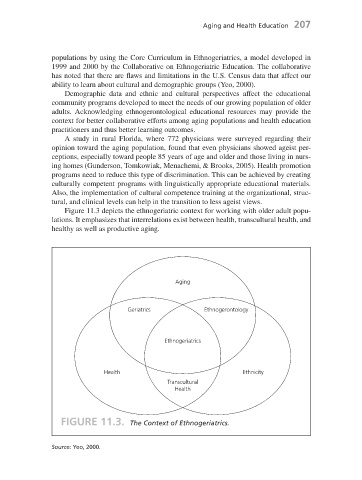
                           Figure  11.3  depicts the ethnogeriatric context for working with older adult popu-
                       lations. It emphasizes that interrelations exist between health, transcultural health, and
                       healthy as well as productive aging.


                                                         Aging


                                            Geriatrics           Ethnogerontology


                                                      Ethnogeriatrics


                                     Health                                 Ethnicity
                                                       Transcultural
                                                         Health


                         FIGURE 11.3.  The Context of Ethnogeriatrics.


                       Source:  Yeo, 2000.


                                                                                                  7/1/08   3:01:52 PM
          c11.indd   207                                                                          7/1/08   3:01:52 PM
          c11.indd   207

