


Page 155 - Curvature and Homology
P. 155
4.3.  LOCAL  GEOMETRY                137
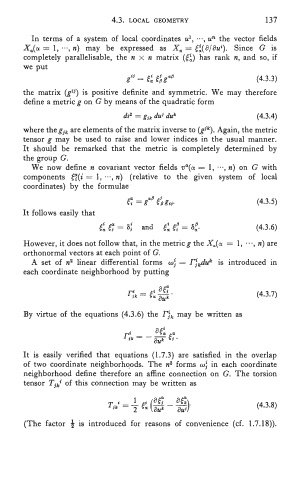
         In terms of  a system of  local  coordinates ul, ..., un the vector fields
       X&  = 1, ..., n)  may  be  expressed  as  Xa = fi(a/aui).  Since  G  is
       completely parallelisable,  the  n x n matrix  (6;)  has  rank  n, and  so, if
       we put
                               g" = ft f;                      (4.3.3)
       the  matrix  (gij) is  positive definite and  symmetric.  We  may  therefore
       define a metric g on G by means of the quadratic form


       where thegjk are elements of the matrix inverse to (gjk). Again, the metric
       tensor g  may  be  used to raise  and lower indices in the usual  manner.
       It  should  be  remarked  that  the  metric  is  completely  determined  by
       the group G.
         We  now  define n  covariant vector fields va(a = 1, ..a,  n)  on  G with
       components  f?(i = 1, .-., n)  (relative  to  the  given  system  of  local
       coordinates)  by  the  formulae
                                c = gap 4 gu.
       It follows easily that


       However, it does not follow that, in the metric g the X,(a  = 1,  ..a,  n) are
       orthonormal vectors at each point of G.
         A  set  of  n2 linear  differential forms  oj = c&uk  is  introduced  in
       each coordinate neighborhood by putting


       By virtue  of  the equations (4.3.6)  the qk  may  be written  as


       It is  easily  verified  that  equations  (1.7.3)  are  satisfied  in  the  overlap
       of  two coordinate neighborhoods. The d forms oj in each coordinate
       neighborhood define therefore  an  affine connection on  G.  The torsion
       tensor  Tjkf of  this connection may  be written  as


       (The factor   is  introduced  for  reasons  of  convenience (cf.  1.7.18)).

