


Page 159 - Curvature and Homology
P. 159
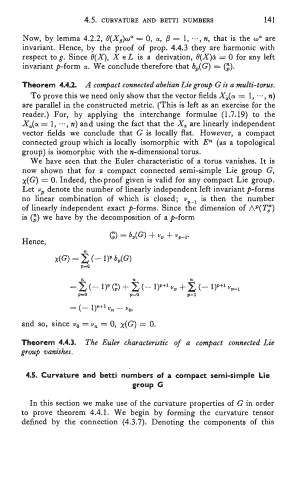
4.5.  CURVATURE AND  BETTI  NUMBERS         141

       Now,  by lemma 4.2.2,  B(XP)wa  = 0,  a,   = 1, --, n,  that is the wa are
      invariant. Hence, by  the  proof  of  prop. 4.4.3  they are harmonic with
      respect to g.  Since B(X), X E L  is  a  derivation, B(X)& = 0 for any left
      invariant p-form  a. We conclude therefore that b,(G)  = (i).
      Theorem  4.4.2.   A compact connected abelian Lie group G is a multi-torus.
        To prove this we need only show that the vector fields X&(a  = 1, -, n)
      are parallel in the constructed metric. (This is left as an exercise for the
      reader.)  For,  by  applying  the  interchange  formulae  (1.7.19)  to  the
      X,(u = 1, a*.,  n) and using the fact that the Xa are linearly independent
      vector fields  we  conclude  that  G is locally flat.  However,  a  compact
      connected group which is locally  isomorphic with  En (as a topological
      group) is isomorphic with the n-dimensional torus.
        We have seen that the Euler  characteristic of  a torus vanishes.  It is
      now  shown  that  for  a  compact  connected  semi-simple  Lie  group  G,
      x(G) = 0. Indeed, theaproof given is valid for any compact  Lie group.
      Let  v,  denote the number of linearly independent left invariant p-forms
      no  linear  combination  of  which  is  closed;  v,,   is  then  the  number
      of  linearly independent  exact p-forms.  Since the dimension of  AP(T,*)
      is (g) we have by the decomposition of  a p-form


                  = (-  lp+l v,,  - Yo,
      and  so,  since v,  = v,  = 0,  x(G) = 0.

      Theorem 4.4.3.   The  Euler  characteristic  of  d compact  connected Lie
      group vanishes.


       4.5.  Curvature and  betti  numbers of  a compact  semi-simple  Lie
                                 group G

        In this section we make use of the curvature properties of  G in order
      to  prove  theorem  4.4.1.  We  begin  by  forming  the  curvature  tensor
      defined  by  the  connection  (4.3.7).  Denoting  the  components  of  this

