


Page 160 - Curvature and Homology
P. 160
142                IV.  COMPACT LIE GROUPS
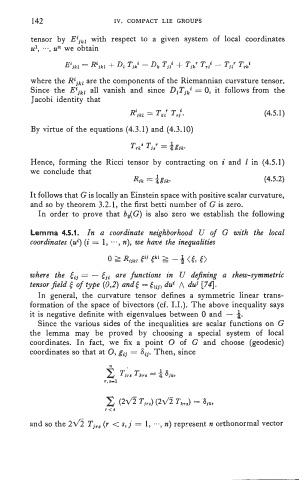
         tensor  by  Eijkl with  respect  to  a  given  system  of  local  coordinates
         ul,  -a,  un we obtain


        where the Ri,,,  are the components of the Riemannian curvature tensor.
        Since  the  Ejkl all  vanish  and  since  D,Tj,"   0,  it  follows from  the
         Jacobi identity  that


         By  virtue of  the equations (4.3.1)  and (4.3.10)


        Hence,  forming  the  Ricci tensor  by  contracting  on i and  1 in  (4.5.1)
        we  conclude that
                                 Rjk = h,k*
        It follows that G is locally an Einstein space with positive scalar curvature,
        and so by theorem 3.2.1,  the first betti number of  G is zero.
          In order to prove that  b,(G)  is also zero we  establish the following
        Lemma 4.5.1.   In  a  coordinate  naghborhood  U of  G  with  the  local
        coordinates (ui) (i = 1, .so,  n), we  have the inequalities


        where  the  fij = - fji  are functions  in  U defining  a  skew-symmetric
        tensor $eld  f  of  type (0,2) andf = t(ij, dui  A  duj [74.
          In  general,  the  curvature  tensor  defines  a  symmetric  linear  trans-
        formation of  the space of  bivectors (cf. 1.1.).  The above inequality says
        it is negative definite with eigenvalues between 0 and - 4.
          Since the various sides of  the inequalities are scalar functions on  G
        the  lemma  may  be  proved  by  choosing  a  special  system  of  local
        coordinates.  In  fact,  we  fix  a  point  0 of  G  and  choose  (geodesic)
        coordinates so that at 0, gij = 8;.  Then, since


        and so the 21/Z TI,  (r < s, j  = I,  am.,  n) represent n orthonormal vector

