


Page 165 - Curvature and Homology
P. 165
5.1  COMPLEX MANIFOLDS                147

                          5.1.  Complex  manifolds
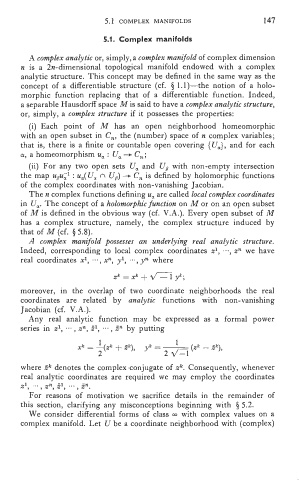
        A complex analytic or, simply, a complex manifold of complex dimension
      n  is  a  2n-dimensional  topological  manifold  endowed  with  a  complex
      analytic structure.  This concept may be defined in the same way as the
      concept  of  a  differentiable  structure (cf.  $ 1.1)-the   notion  of  a  holo-
      morphic  function  replacing  that  of  a  differentiable function.  Indeed,
      a separable Hausdorff space M is said to have a complex analytic structure,
      or, simply, a complex structure if  it possesses the properties:
        (i)  Each  point  of  M  has  an  open  neighborhood  homeomorphic
      with an open subset in Cn, the (number) space of  n complex variables;
      that is,  there is a finite or countable open covering {U,),  and for  each
      a, a homeomorphism u,  : U, -+  C,,
                                    ;
        (ii)  For  any  two  open  sets  U,  and  Up with  non-empty  intersection
      the map up;l  : ua(Ua n Up) --+ Cn is defined by  holomorphic functions
      of  the complex coordinates with  non-vanishing  Jacobian.
        The n complex functions defining u,  are called local complex coordinates
      in  U,.  The concept of a holomorphic function on M or on an open subset
      of  M is defined in the obvious way (cf.  V.A.).  Every open subset of  M
      has  a  complex  structure,  namely,  the  complex  structure  induced  by
      that of  M (cf.  $ 5.8).
        A  complex  manifold possesses  an  unhlying  real  analytic  structure.
      Indeed,  corresponding to local  complex  coordinates  zl, .-., zn we  have
      real  coordinates  xl,  as-,  xn, yl, -.. , yn where


      moreover,  in  the  overlap  of  two  coordinate  neighborhoods  the  real
      coordinates  are  relateai  by  analytic  functions  with  non-vanishing
      Jacobian  (cf.  V.A.).
        Any  real  analytic  function  may  be  expressed  as  a  formal  power
      series in  zl,  , zn, i?,   , Zn by  putting


      where Zk denotes the complex -conjugate of zk. Consequently,  whenever
      real  analytic  coordinates  are  required  we  may  employ  the  coordinates
      .$,  ... , zfi, 51,  *-*,  zn.
        For  reasons  of  motivation  we  sacrifice  details  in  the  remainder  of
      this section,  clarifying  any  misconceptions  beginning with  $5.2.
        We  consider  differential forms of  class  00  with  complex  values  on a
      complex manifold.  Let  U be a coordinate neighborhood with (complex)

