


Page 162 - Curvature and Homology
P. 162
144                 IV.  COMPACT LIE  GROUPS

          2)  The group B,:  this is the orthogonal group in (21 + 1)-space the
        elements of  which  have  determinant + 1 ;
          3)  The group C,:  this is the symplectic group in 21-space, that is C,
        is  the  group  of  unitary  transformations  leaving  invariant  the  skew-
        symmetric bilinear form Z&,  auxtyi where the coefficients are given by
        a,-,,,   -       = 1 with  all other  a,*  = 0;
              - - a ,,,-I
          4)  The group  Dl of  orthogonal transformations  in  21-space  (1 = 3,
        4,  *em),  the elements of  which have determinant + 1.

          There  are  also  five  exceptional compact  simple  Lie  groups  whose
        dimensions  are  14,  52,  78,  133,  and  248  commonly  denoted by  G,,
        F,,  E,,  E,,  and  E,,  respectively.
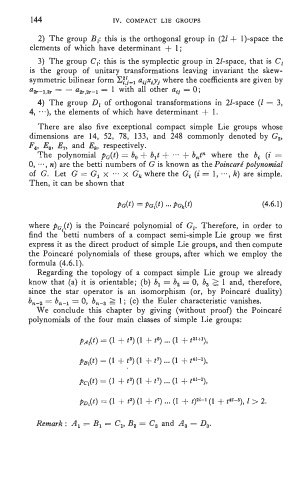
          The  polynomial  pG(t)  = b,  + b,t  +  + b,tn  where  the  b4  (i  =
        0,  -a,  n) are the betti numbers of  G is known as the Poincard polynomial
        of  G.  Let  G = G,  x   x  G,  where the Gd (i = 1, ..., k) are simple.
        Then, it can be shown that


        where pGI(t) is the PoincarC  polynomial of  G,.  Therefore, in order to
        find  the  betti  numbers  of  a  compact  semi-simple Lie  group  we  first
        express it as the direct product of  simple Lie groups, and then compute
        the PoincarC polynomials  of  these  groups, after  which we  employ  the
        formula (4.6.1).
          Regarding the topology of  a compact  simple  Lie group  we  already
        know  that  (a) it is orientable; (b) b,  = b,  = 0,  b3 2 1 and,  therefore,
        since  the  star  operator  is  an  isomorphism  (or,  by  PoincarC  duality)
        bn-,  = bn-,  = 0, b,-,  2 1 ; (c) the Euler  characteristic vanishes.
          We  conclude  this  chapter  by  giving  (without  proof)  the  PoincarC
        polynomials of  the four  main  classes of  simple Lie groups:


          Remark : A,  = B1 = C1, B, = C2 and  A3 = Ds.

