


Page 157 - Curvature and Homology
P. 157
4.4  HARMONIC FORMS                 139

           4.4.  Harmonic forms  on  a compact semi-simple  Lie group

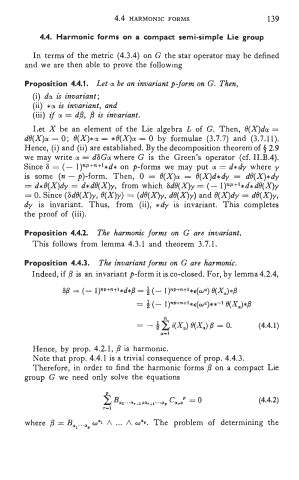
         In terms of  the metric  (4.3.4)  on G the star operator may be defined
       and we  are then able to prove the following

       Proposition 4.4.1.   Let a be  an invariant p-form  on  G.  Then,
         (i)  da is invariant;
         (ii)  *a is invariant, and
         (iii)  if  a = d/3,  /3  is  invariant.
         Let  X  be  an  element  of  the  Lie  algebra  L  of  G.  Then,  B(X)da =
       dB(X)a = 0; B(X)*a = *B(X)a = 0 by  formulae  (3.7.7)  and  (3.7.11).
       Hence, (i) and (ii) are established. By the decomposition theorem of 5 2.9
       we may write a = d8Ga where G  is  the  Green's  operator  (cf. II.B.4).
       Since 6 = (-  l)np+n+l*d* on  p-forms  we  may  put  a = d*dy  where y
       is  some  (n - p)-form.  Then,  0 = B(X)a  = 9(X)d*dy  = dB(X)*dy
       = dd(X)dy = d*dB(X)y,  from which 8dO(X)y = (-  l)np+l*d*dO(X)y
       = 0. Since (SdB(X)y, B(X)y) = (dB(+,   dB(X)y) and B(X)dy  = dB(+,
       dy  is  invariant.  Thus,  from  (ii),  *dy  is  invariant.  This  completes
       the proof  of  (iii).
       Proposition 4.4.2.   The  harmonic forms  on  G  are  invariant.
         This follows from  lemma 4.3.1  and theorem  3.7.1.

       Proposition 4.4.3.   The invariant forms  on  G are harmonic.
         Indeed, if /3  is an invariant p-form it is co-closed. For, by lemma 4.2.4,


         Hence, by  prop. 4.2.1,  /3  is  harmonic.
         Note that prop. 4.4.1 is a trivial consequence of  prop. 4.4.3.
         Therefore, in order to find the  harmonic forms /3  on a compact  Lie
       group  G we  need  only solve the equations


       where  /3  = B4..   'ral  A  ... A  'rap.  The  problem  of  determining  the

