


Page 161 - Curvature and Homology
P. 161
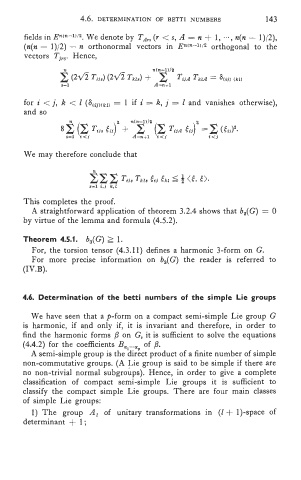
fields in En(n-l)J2. We denote by  TA,, (r < s, A  = n + 1, ---, - 1)/2),
                                                          n(n
       (n(n - 1)/2) - n  orthonormal  vectors  in  En(n-1)/2 orthagonal  to  the
       vectors  Tj,.  Hence,


       for  i < j,  k < I  (S(il)(kl) = 1 if  i = k, j = I  and  vanishes  otherwise),
       and so
                                 n(n-l)/%
                8 2 (2 Tij.  +  2  (2 Tij~ fij)l = 2
                 s=l  id         A=n+l   ici       i <j

       We may therefore conclude that


       This completes the proof.
         A straightforward  application of  theorem 3.2.4  shows that b2(G) = 0
       by virtue of the lemma and formula (4.5.2).

       Theorem 4.5.1.   b3(G) 5 1.
         For, the torsion  tensor (4.3.1 1) defines a harmonic  3-form on G.
         For  more  precise  information  on  b3(G)  the  reader  is  referred  to
       (1V.B).


       4.6.  Determination  of  the  betti  numbers of  the  simple  Lie groups

         We have seen that a p-form  on a compact semi-simple  Lie group G
       is  harmonic,  if  and  only  if,  it  is  invariant  and  therefore,  in  order  to
       find the harmonic forms  /3  on  G, it is sufficient to solve the equations
       (4.4.2)  for the coefficients Ba   ap  of  8.
         A semi-simple group is the direct product of a finite number of simple
       non-commutative  groups. (A Lie group is said to be simple if  there are
       no  non-trivial  normal  subgroups).  Hence,  in  order  to  give a complete
       classification  of  compact  semi-simple  Lie  groups  it  is  sufficient  to
       classify  the  compact  simple  Lie  groups.  There  are  four  main  classes
       of  simple  Lie groups:
         1) The  group  A,  of  unitary  transformations  in  (1 + 1)-space  of
       determinant + 1 ;

