


Page 166 - Curvature and Homology
P. 166
1 48                 V.  COMPLEX  MANIFOLDS

        coordinates  zl, ..-, zn. Then,  the  differentials dzl,  -.., dzn constitute  a
        (complex) base for the differential forms of  degree 1. It follows that a
        differential form  of  degree  p  may  be  expressed  in  U as  a  linear
        combination  (with  complex-valued  coefficients of  class w)  of  exterior
        products  of  p-forms  belonging  to  the  sets  {dzi}  and  {dZi}.  A  term
        consisting of  q of  the  {dzi}  and r of  the  {dZi} with  q + r  = p is said
        to be  of  bidegree  (q, r).  A differential form of  bidegree  (q, r)  is a sum
        of  terms of  bidegree  (q, r).  The notion of  a form of  bidegree  (q, r)  is
        independent of  the choice of  local coordinates  since in  the overlap of
        two  coordinate  neighborhoods  the  coordinates  are  related  by  holo-
        morphic functions.  A  differential form on M  is said  to  be of  bidegree
        (q, r) if it is of bidegree (q, r) in a neighborhood of  each point.
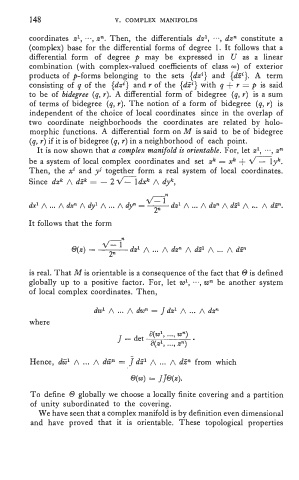
          It is now shown that a complex manifold is orientable. For, let zl,  ..a,  zn
        be a system of  local complex coordinates and  set  zk = sL + C  y  k  .
        Then,  the xi  and yJ together  form  a  real  system of  local  coordinates.
        Since  dzk A dZk = - 2 Gld2 A  dyk,


        It follows that the form


        is real. That M is orientable is a consequence of the fact that 8 is defined
        globally up  to  a  positive  factor.  For,  let  wl,  ..., wn  be  another  system
        of  local complex coordinates. Then,

                        dwl  A ... A dwn = Jdzl  A ... A dzn
        where
                                     qwl, ..., wn)
                             J = det
                                     qzl, ...,P)
        Hence,  dfil  A ... A dGn = jdZ1 A ... A  dZn from  which


        To define  8 globally we choose a locally finite covering and a partition
        of  unity  subordinated  to  the  covering.
          We have seen that a complex manifold is by definition even dimensional
        and  have  proved  that  it  is  orientable.  These  topological  properties

