


Page 171 - Curvature and Homology
P. 171
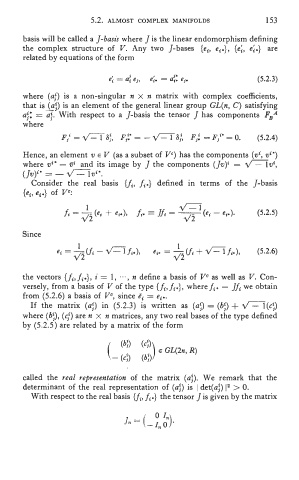
basis will be called a J-basis  where J is the linear endomorphism defining
       the  complex  structure of  V.  Any  two  J-bases  {ei,  e,.),  {ei,  el.}  are
       related by equations of the form


       where  (a:)  is  a  non-singular  n x n  matrix  with  complex  coefficients,
       that is (a:)  is an element of the general linear group GL(n, C) satisfying
       a::  = a:. With  respect to a J-basis  the tensor  J has  components  FBA
       where
                                               F,:
                                                    Fji*
                                                  =
                F,'  =        F:   = - ~XS:, 0.                (5.2.4)
                                                        =
       Hence, an element v E V (as a subset of  Vc) has the components (vi, vi*)
       where vi* = Ci  and  its image by  J the components (Jv)'  = dqvi,
       (Jv)i* = - dqvi*.
         Consider  the  real  basis  Cfi, fi,)  defined  in  terms  of  the  J-basis
       {e,,  e5*)  of  Vc:


       Since


       the vectors {fi, fi.},  i = 1, ..., n define a basis of  Vc as well as V.  Con-
       versely, from a basis of  V of the type (fi, f,,),  where&,  = Jf, we obtain
       from (5.2.6)  a basis of  Vc, since gi  = e,,.
         If  the  matrix  (a:)  in  (5.2.3)  is  written  as (a2 = (bj) + d?(ci)
       where (b;),  (cj) are n  x  n matrices, any two real bases of the type defined
       by (5.2.5) are related by a matrix of the form


       called  the  real  representation of  the  matrix  (a:).  We  remark  that  the
       determinant  of the real representation of  (a:)  is I det(a:)  I2  > 0.
         With respect to the real basis Cfi, fie) the tensor J is given by the matrix

