


Page 172 - Curvature and Homology
P. 172
154                  V.  COMPLEX  MANIFOLDS

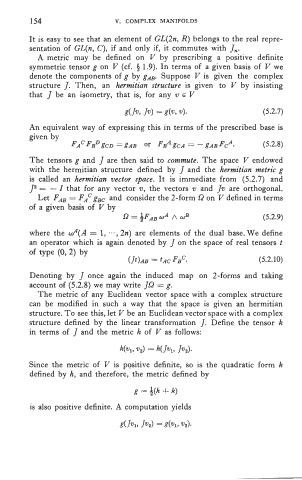
        It is easy to see that an element of  GL(2n, R) belongs to the real repre-
        sentation of  GL(n, C), if  and only if, it commutes with J,.
          A  metric  may  be  defined  on  V  by  prescribing  a  positive  definite
        symmetric tensor g on  V (cf.  § 1.9). In terms of  a given basis of  V we
        denote the components of g by gA,.  Suppose  V is  given  the  complex
        structure J. Then,  an  hermitian structure is  given  to  V  by  insisting
        that  J be  an isometry,  that  is,  for  any v E V


        An  equivalent way of  expressing this in terms of  the prescribed base is


        The tensors g and J are then  said to commute.  The space V endowed
        with  the hermitian structure  defined  by  J and  the  hermitian metric g
        is  called  an  hermitian  vector  space.  It  is  immediate  from  (5.2.7)  and
        J2 = - I that  for  any vector a, the vectors v  and  Jv are orthogonal.
          Let FAB = FAC gBC and  consider the 2-form 52 on V defined in terms
        of  a given basis of  V by
                               l2 =&FABwA  A  wB                (5.2.9)

        where the uA(A = 1, ..., 2n)  are elements of  the  dual base. We define
        an operator which is again denoted by J on the space of  real tensors t
        of type (092) by
                                ( JZ)AB = ~AC FB'.             (5.2.10)
        Denoting  by  J once  again  the  induced  map  on  2-forms  and  taking
        account of  (5.2.8)  we may write JSZ = g.
          The metric of  any Euclidean vector space with  a complex  structure
        can  be  modified  in  such  a  way  that  the  space is  given  an  hermitian
        structure. To see this, let V be an Euclidean vector space with a complex
        structure  defined  by  the  linear transformation  J. Define  the  tensor  k
        in terms of  J and the metric h of  V as follows:


        Since the metric  of  V  is  positive definite, so is the  quadratic form  k
        defined by h,  and therefore, the metric defined by


        is also positive definite. A computation yields

