


Page 175 - Curvature and Homology
P. 175
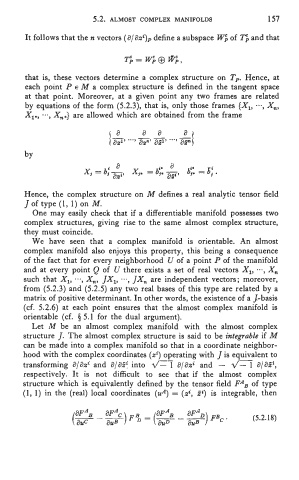
It follows that the n vectors (a/a~i)~ define a subspace W: of  Pp and that


       that is, these vectors determine  a complex structure on  Tp. Hence,  at
       each point  P E M a complex structure is defined in the tangent  space
       at  that  point.  Moreover,  at  a  given  point  any two  frames  are  related
       by equations of  the form (5.2.3),  that is, only those frames {XI, *-,  X,,
       XI,,  -, X,,)  are allowed which are obtained from the frame


       Hence,  the complex structure on  M defines a real analytic tensor  field
       J of type (1, 1) on M.
         One may  easily check that if  a differentiable manifold  possesses two
       complex structures, giving rise to  the same  almost  complex structure,
       they must coincide.
         We  have  seen  that  a  complex  manifold  is  orientable.  An  almost
       complex manifold  also enjoys this  property,  this being  a consequence
       of  the fact that for every neighborhood  U of  a point P of  the manifold
       and  at every point Q of  U there exists a set of  real vectors XI, **.,  X,
       such that XI,  a*.,  X,,  JX,,  ..., JX,  are independent vectors;  moreover,
       from (5.2.3)  and (5.2.5)  any two real bases of  this type are related by a
       matrix of positive determinant. In other words, the existence of a J-basis
       (cf.  5.2.6)  at  each point  ensures  that  the  almost complex manifold  is
       orientable  (cf.  5 5.1  for the dual argument).
         Let  M  be  an  almost  complex  manifold  with  the  almost  complex
       structure J. The almost complex structure is said to be intepabb if  M
       can be made into a complex manifold so that in a coordinate neighbor-
       hood with the complex coordinates (&) operating with J is equivalent to
       transforming  a/azi and  a/aZl into   a/a~i and  - .\/-   a/aZi,
       respectively.  It  is  not  difficult  to  see  that  if  the  almost  complex
       structure which  is equivalently defined by  the tensor field FAB of  type
       (1, 1) in the (real) local coordinates  (uA) = (zi, 50  is  integrable, then

