


Page 170 - Curvature and Homology
P. 170
152                 V.  COMPLEX  MANIFOLDS

        Applying J to both  sides of  this relation gives


        Hence,  the eigenvalues are I/ - 1 and  - <-7,  and so since J is a
        real  operator,  that  is JY= Jc,  the  eigenvectors of  - -1   are the
        conjugates of  those  of  1/?.   The vector  space  V must  therefore  be
        even  dimensional, that  is  m  = 2n.  The eigenvectors of  1/7 form  a
        vector space of complex dimension n which we denote by  F0 and those
       corresponding to - I/?   form the vector space VOgl = V1sO; moreover,


       that  is  Vc = Po @ VOJ (direct  sum).  Thus,  the  tensor  J defines a
        complex  structure  on  V.
         An  element  of  the  eigenspace  Vpo will be called a vector of  bidegree
        (or type) (1,O) and an element of  VOJ  a vector of  bidegree (or type) (0,l).
         A complex structure may  be  defined on the dual space of  V in the
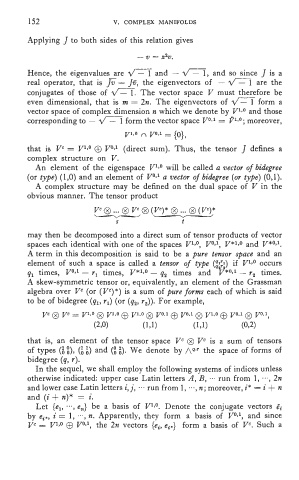
        obvious manner. The tensor product


        may then be decomposed into a direct sum of  tensor products of vector
        spaces each identical with one of  the spaces V1sO, VJ, V*lpO and V*Osl.
        A term in this decomposition is  said to  be  a pure  tensor  space  and  an
        element  of  such  a  space is  called  a  tensor  of  type ($2)  if  Po occurs
        q,  times,  'VOtl  - r,  times,  V*lsO - q,  times  and  V*OJ  - r,  times.
        A skew-symmetric tensor or, equivalently, an element of  the Grassman
        algebra over  Vc (or (VC)*) is a sum of pure forms  each of  which is said
        to be of  bidegree (q,,  r,)  (or (q,,  r,)).  For example,


       that  is,  an  element  of  the  tensor space  VC  @ Vc is  a  sum  of  tensors
        of  types (i g),  (:  i) and (g 9. We  denote  by  //gpr  the  space of  forms of
        bidegree (q, r).
         In the sequel, we shall employ the following systems of  indices unless
        otherwise indicated: upper case Latin letters A, B, ..- run from  1, ..., 2n
        and lower case Latin letters i, j,   run from 1, .-., n; moreover, i* = i + n
        and  (i + n)*  = i.
          Let  {e,,   ..a,  e,)  be  a  basis  of  V1pO. Denote  the  conjugate  vectors  Zd
        by  ed,, i = 1, ..., n.  Apparently,  they  form  a  basis  of  VOJ, and  since
        VC  = PC @ Pa1,  the 2n  vectors  {ed, e,,}   form  a basis  of  VC. Such a

