


Page 664 - Discrete Mathematics and Its Applications
P. 664
10.1 Graphs and Graph Models  643


                                                                                         Detroit
                                                                                 Chicago        New York
                                                     San Francisco
                                                                                             Washington
                                                                       Denver

                                                       Los Angeles

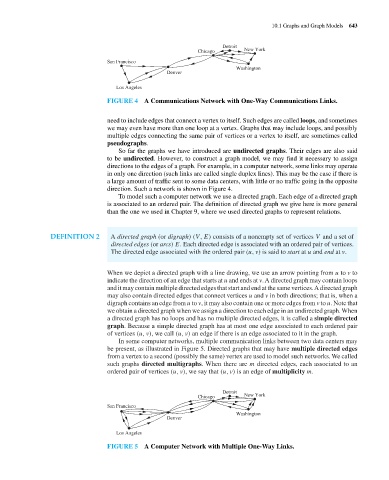
                                                     FIGURE 4 A Communications Network with One-Way Communications Links.

                                                     need to include edges that connect a vertex to itself. Such edges are called loops, and sometimes
                                                     we may even have more than one loop at a vertex. Graphs that may include loops, and possibly
                                                     multiple edges connecting the same pair of vertices or a vertex to itself, are sometimes called
                                                     pseudographs.
                                                        So far the graphs we have introduced are undirected graphs. Their edges are also said
                                                     to be undirected. However, to construct a graph model, we may find it necessary to assign
                                                     directions to the edges of a graph. For example, in a computer network, some links may operate
                                                     in only one direction (such links are called single duplex lines). This may be the case if there is
                                                     a large amount of traffic sent to some data centers, with little or no traffic going in the opposite
                                                     direction. Such a network is shown in Figure 4.
                                                        To model such a computer network we use a directed graph. Each edge of a directed graph
                                                     is associated to an ordered pair. The definition of directed graph we give here is more general
                                                     than the one we used in Chapter 9, where we used directed graphs to represent relations.


                                   DEFINITION 2       A directed graph (or digraph) (V, E) consists of a nonempty set of vertices V and a set of
                                                      directed edges (or arcs) E. Each directed edge is associated with an ordered pair of vertices.
                                                      The directed edge associated with the ordered pair (u, v) is said to start at u and end at v.


                                                     When we depict a directed graph with a line drawing, we use an arrow pointing from u to v to
                                                     indicate the direction of an edge that starts at u and ends at v.A directed graph may contain loops
                                                     and it may contain multiple directed edges that start and end at the same vertices.A directed graph
                                                     may also contain directed edges that connect vertices u and v in both directions; that is, when a
                                                     digraph contains an edge from u to v, it may also contain one or more edges from v to u. Note that
                                                     we obtain a directed graph when we assign a direction to each edge in an undirected graph.When
                                                     a directed graph has no loops and has no multiple directed edges, it is called a simple directed
                                                     graph. Because a simple directed graph has at most one edge associated to each ordered pair
                                                     of vertices (u, v), we call (u, v) an edge if there is an edge associated to it in the graph.
                                                        In some computer networks, multiple communication links between two data centers may
                                                     be present, as illustrated in Figure 5. Directed graphs that may have multiple directed edges
                                                     from a vertex to a second (possibly the same) vertex are used to model such networks. We called
                                                     such graphs directed multigraphs. When there are m directed edges, each associated to an
                                                     ordered pair of vertices (u, v), we say that (u, v) is an edge of multiplicity m.


                                                                                         Detroit
                                                                                 Chicago        New York
                                                     San Francisco
                                                                                             Washington
                                                                       Denver

                                                       Los Angeles

                                                     FIGURE 5 A Computer Network with Multiple One-Way Links.

