


Page 668 - Discrete Mathematics and Its Applications
P. 668
10.1 Graphs and Graph Models  647


                                                     first document cites the second in its citation list. (In an academic paper, the citation list is the
                                                     bibliography, or list of references; in a patent it is the list of previous patents that are cited; and
                                                     in a legal opinion it is the list of previous opinions cited.) A citation graph is a directed graph
                                                     without loops or multiple edges.                                               ▲

                                                     SOFTWARE DESIGN APPLICATIONS Graph models are useful tools in the design of
                                                     software. We will briefly describe two of these models here.

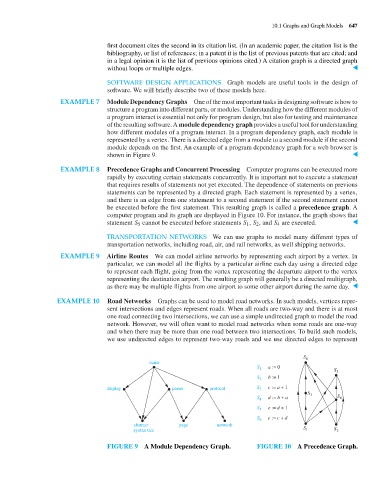
                                      EXAMPLE 7      Module Dependency Graphs   One of the most important tasks in designing software is how to
                                                     structure a program into different parts, or modules. Understanding how the different modules of
                                                     a program interact is essential not only for program design, but also for testing and maintenance
                                                     of the resulting software.A module dependency graph provides a useful tool for understanding
                                                     how different modules of a program interact. In a program dependency graph, each module is
                                                     represented by a vertex. There is a directed edge from a module to a second module if the second
                                                     module depends on the first. An example of a program dependency graph for a web browser is
                                                     shown in Figure 9.                                                             ▲

                                      EXAMPLE 8      Precedence Graphs and Concurrent Processing Computer programs can be executed more
                                                     rapidly by executing certain statements concurrently. It is important not to execute a statement
                                                     that requires results of statements not yet executed. The dependence of statements on previous
                                                     statements can be represented by a directed graph. Each statement is represented by a vertex,
                                                     and there is an edge from one statement to a second statement if the second statement cannot
                                                     be executed before the first statement. This resulting graph is called a precedence graph.A
                                                     computer program and its graph are displayed in Figure 10. For instance, the graph shows that
                                                     statement S 5 cannot be executed before statements S 1 , S 2 , and S 4 are executed.  ▲
                                                    TRANSPORTATION NETWORKS We can use graphs to model many different types of
                                                     transportation networks, including road, air, and rail networks, as well shipping networks.
                                      EXAMPLE 9     Airline Routes We can model airline networks by representing each airport by a vertex. In
                                                     particular, we can model all the flights by a particular airline each day using a directed edge
                                                     to represent each flight, going from the vertex representing the departure airport to the vertex
                                                     representing the destination airport. The resulting graph will generally be a directed multigraph,
                                                     as there may be multiple flights from one airport to some other airport during the same day.  ▲

                                     EXAMPLE 10      Road Networks   Graphs can be used to model road networks. In such models, vertices repre-
                                                     sent intersections and edges represent roads. When all roads are two-way and there is at most
                                                     one road connecting two intersections, we can use a simple undirected graph to model the road
                                                     network. However, we will often want to model road networks when some roads are one-way
                                                     and when there may be more than one road between two intersections. To build such models,
                                                     we use undirected edges to represent two-way roads and we use directed edges to represent


                                                                                                                  S 6
                                                                  main
                                                                                                    S 1  a := 0
                                                                                                                            S 5
                                                                                                       b := 1
                                                                                                    S 2
                                                     display             parser      protocol       S 3  c := a + 1
                                                                                                                    S 3
                                                                                                    S 4  d := b + a          S 4
                                                                                                    S 5  e := d + 1
                                                                                                    S 6  e := c + d
                                                             abstract      page        network
                                                             syntax tree                                          S 1       S 2

                                                     FIGURE 9 A Module Dependency Graph.            FIGURE 10 A Precedence Graph.

