


Page 212 - DSP Integrated Circuits
P. 212
5.4 Quantization In WDFs                                             197

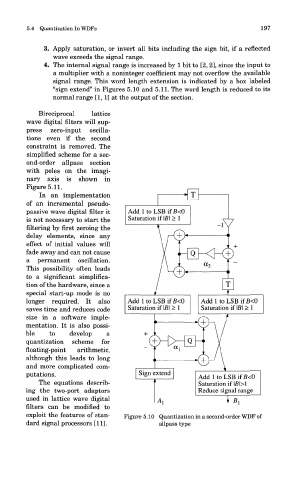
              3. Apply saturation, or invert all bits including the sign bit, if a reflected
                wave exceeds the signal range.
              4. The internal signal range is increased by 1 bit to [2, 2], since the input to
                a multiplier with a noninteger coefficient may not overflow the available
                signal range. This word length extension is indicated by a box labeled
                "sign extend" in Figures 5.10 and 5.11. The word length is reduced to its
                normal range [1,1[ at the output of the section.

            Bireciprocal    lattice
        wave digital filters will sup-
        press zero-input oscilla-
        tions even if the second
        constraint is removed. The
         simplified scheme for a sec-
        ond-order allpass section
        with poles on the imagi-
        nary axis is shown in
        Figure b. 11.
            In an implementation
        of an incremental pseudo-
        passive wave digital filter it
        is not necessary to start the
        filtering by first zeroing the
        delay elements, since any
        effect of initial values will
        fade away and can not cause
        a permanent oscillation.
        This possibility often leads
        to a significant simplifica-
        tion of the hardware, since a
        special start-up mode is no
        longer required. It also
        saves time and reduces code
        size in a software imple-
        mentation. It is also possi-
        ble    to    develop    a
        quantization scheme for
        floating-point  arithmetic,
        although this leads to long
        and more complicated com-
        putations.
            The equations describ-
        ing the two-port adaptors
        used in lattice wave digital
        filters can be modified to
        exploit the features of stan-  Figure 5.10 Quantization in a second-order WDF of
        dard signal processors [11].            allpass type

