


Page 142 - Design of Solar Thermal Power Plants
P. 142
3.2 HELIOSTAT FIELD EFFICIENCY ANALYSIS    127


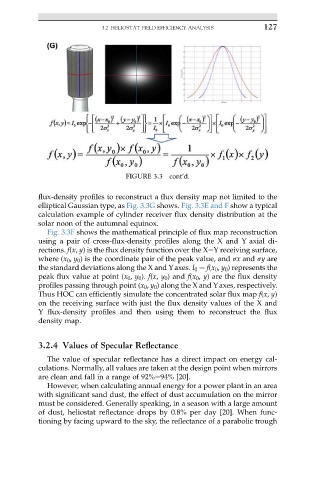
                                   FIGURE 3.3 cont’d.


           flux-density profiles to reconstruct a flux density map not limited to the
           elliptical Gaussian type, as Fig. 3.3G shows. Fig. 3.3E and F show a typical
           calculation example of cylinder receiver flux density distribution at the
           solar noon of the autumnal equinox.
              Fig. 3.3F shows the mathematical principle of flux map reconstruction
           using a pair of cross-flux-density profiles along the X and Y axial di-
           rections. f(x, y) is the flux density function over the XeY receiving surface,
           where (x 0 , y 0 ) is the coordinate pair of the peak value, and sx and sy are
           the standard deviations along the X and Yaxes. I 0 ¼ f(x 0 , y 0 ) represents the
           peak flux value at point (x 0 , y 0 ). f(x, y 0 ) and f(x 0 , y) are the flux density
           profiles passing through point (x 0 , y 0 ) along the X and Yaxes, respectively.
           Thus HOC can efficiently simulate the concentrated solar flux map f(x, y)
           on the receiving surface with just the flux density values of the X and
           Y flux-density profiles and then using them to reconstruct the flux
           density map.


           3.2.4 Values of Specular Reflectance
              The value of specular reflectance has a direct impact on energy cal-
           culations. Normally, all values are taken at the design point when mirrors
           are clean and fall in a range of 92%e94% [20].
              However, when calculating annual energy for a power plant in an area
           with significant sand dust, the effect of dust accumulation on the mirror
           must be considered. Generally speaking, in a season with a large amount
           of dust, heliostat reflectance drops by 0.8% per day [20]. When func-
           tioning by facing upward to the sky, the reflectance of a parabolic trough

