


Page 144 - Design of Solar Thermal Power Plants
P. 144
3.2 HELIOSTAT FIELD EFFICIENCY ANALYSIS    129

           energy attenuation of the solar beam, and the nonuniform air refractive
           index may result in the variation of amplitude and phase of the optical
           wave. When the power of the optical wave is large enough and lasts for an
           extremely short time, the nonlinearity effect may also influence the
           characteristics of solar beams.
              The integrated effects of absorption and scattering results in atten-
           uation of the radiant intensity of transmitted light. Partial energy of
           incident light is converted into other forms of energy through absorp-
           tion (such as thermal), and partial energy deviates from its original
           direction due to scattering (namely spatial reallocation of radiation
           energy).
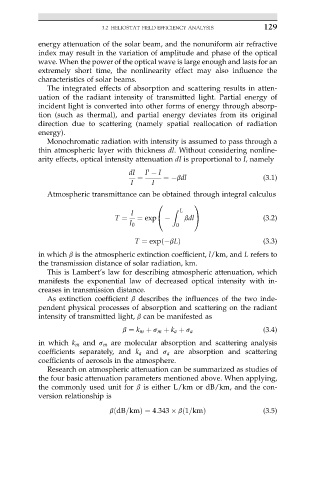
              Monochromatic radiation with intensity is assumed to pass through a
           thin atmospheric layer with thickness dl. Without considering nonline-
           arity effects, optical intensity attenuation dI is proportional to I, namely

                                    dI  I   I
                                         0
                                      ¼      ¼ bdl                      (3.1)
                                    I     I
              Atmospheric transmittance can be obtained through integral calculus
                                           0         1
                                    I           Z  L
                                T ¼   ¼ exp @      bdl A                (3.2)
                                    I 0          0
                                     T ¼ expð bLÞ                       (3.3)
           in which b is the atmospheric extinction coefficient, l/km, and L refers to
           the transmission distance of solar radiation, km.
              This is Lambert’s law for describing atmospheric attenuation, which
           manifests the exponential law of decreased optical intensity with in-
           creases in transmission distance.
              As extinction coefficient b describes the influences of the two inde-
           pendent physical processes of absorption and scattering on the radiant
           intensity of transmitted light, b can be manifested as

                                  b ¼ k m þ s m þ k a þ s a             (3.4)
           in which k m and s m are molecular absorption and scattering analysis
           coefficients separately, and k a and s a are absorption and scattering
           coefficients of aerosols in the atmosphere.
              Research on atmospheric attenuation can be summarized as studies of
           the four basic attenuation parameters mentioned above. When applying,
           the commonly used unit for b is either L/km or dB/km, and the con-
           version relationship is

                               bðdB=kmÞ¼ 4:343   bð1=kmÞ                (3.5)

