


Page 148 - Design of Solar Thermal Power Plants
P. 148
3.2 HELIOSTAT FIELD EFFICIENCY ANALYSIS    133

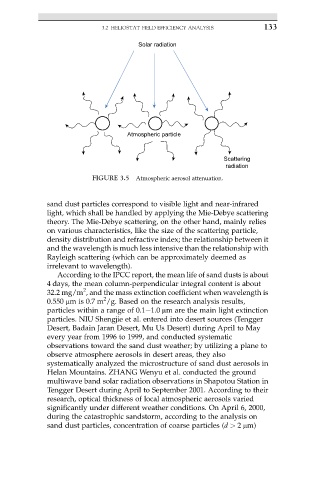
                                      Solar radiation


                                   Atmospheric particle


                                                             Scattering
                                                              radiation
                          FIGURE 3.5  Atmospheric aerosol attenuation.


              sand dust particles correspond to visible light and near-infrared
              light, which shall be handled by applying the Mie-Debye scattering
              theory. The Mie-Debye scattering, on the other hand, mainly relies
              on various characteristics, like the size of the scattering particle,
              density distribution and refractive index; the relationship between it
              and the wavelength is much less intensive than the relationship with
              Rayleigh scattering (which can be approximately deemed as
              irrelevant to wavelength).
                 According to the IPCC report, the mean life of sand dusts is about
              4 days, the mean column-perpendicular integral content is about
                        2
              32.2 mg/m , and the mass extinction coefficient when wavelength is
                             2
              0.550 mm is 0.7 m /g. Based on the research analysis results,
              particles within a range of 0.1e1.0 mm are the main light extinction
              particles. NIU Shengjie et al. entered into desert sources (Tengger
              Desert, Badain Jaran Desert, Mu Us Desert) during April to May
              every year from 1996 to 1999, and conducted systematic
              observations toward the sand dust weather; by utilizing a plane to
              observe atmosphere aerosols in desert areas, they also
              systematically analyzed the microstructure of sand dust aerosols in
              Helan Mountains. ZHANG Wenyu et al. conducted the ground
              multiwave band solar radiation observations in Shapotou Station in
              Tengger Desert during April to September 2001. According to their
              research, optical thickness of local atmospheric aerosols varied
              significantly under different weather conditions. On April 6, 2000,
              during the catastrophic sandstorm, according to the analysis on
              sand dust particles, concentration of coarse particles (d > 2 mm)

