


Page 153 - Design of Solar Thermal Power Plants
P. 153
138         3. GENERAL DESIGN OF A SOLAR THERMAL POWER PLANT

               For a 100 MW-level power tower plant, area of the concentration field is
            about 1 million square meters. The last row of heliostats is 2 km away
            from the tower.
                            T ¼ expð bLÞ¼ expð 0:02   2Þ¼ 0:96


            3.2.6 Heat Losses of Power Tower Cavity Receiver
               Receiver is the device in the CSP generation system that converts solar
            energy into thermal energy. Receiver of the power tower generation system
            is normally mounted at the top of the receiver tower. There are mainly two
            types of receivers, cavity type and cylinder type receivers. The cavity
            receiver is used to absorb the solar radiation collected by the concentration
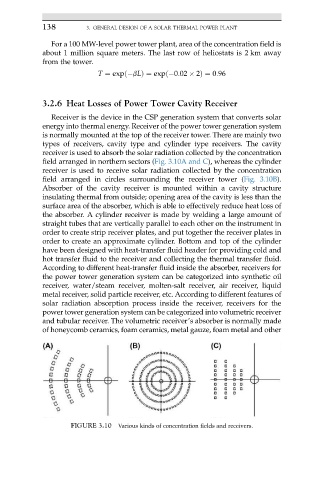
            field arranged in northern sectors (Fig. 3.10A and C), whereas the cylinder
            receiver is used to receive solar radiation collected by the concentration
            field arranged in circles surrounding the receiver tower (Fig. 3.10B).
            Absorber of the cavity receiver is mounted within a cavity structure
            insulating thermal from outside; opening area of the cavity is less than the
            surface area of the absorber, which is able to effectively reduce heat loss of
            the absorber. A cylinder receiver is made by welding a large amount of
            straight tubes that are vertically parallel to each other on the instrument in
            order to create strip receiver plates, and put together the receiver plates in
            order to create an approximate cylinder. Bottom and top of the cylinder
            have been designed with heat-transfer fluid header for providing cold and
            hot transfer fluid to the receiver and collecting the thermal transfer fluid.
            According to different heat-transfer fluid inside the absorber, receivers for
            the power tower generation system can be categorized into synthetic oil
            receiver, water/steam receiver, molten-salt receiver, air receiver, liquid
            metal receiver, solid particle receiver, etc. According to different features of
            solar radiation absorption process inside the receiver, receivers for the
            power tower generation system can be categorized into volumetric receiver
            and tubular receiver. The volumetric receiver’s absorber is normally made
            of honeycomb ceramics, foam ceramics, metal gauze, foam metal and other


                    FIGURE 3.10  Various kinds of concentration fields and receivers.

