


Page 152 - Design of Solar Thermal Power Plants
P. 152
3.2 HELIOSTAT FIELD EFFICIENCY ANALYSIS    137

              and particles with the size of 0.1e0.4 mm have the largest
              contributions to the total extinction coefficient; peak value of
              extinction appears when the particle size approximates 0.2 mm,
              b(440) ¼ 0.36/km. Along with the increase of particle size, extinction
              coefficient decreases rapidly; when the particle size reaches up to
              1.0 mm, extinction coefficient has already approached 0. Then, based
              on the variation of extinction coefficient over wavelength, aerosol
              particle has the best extinction ability when the wavelength is
              440 nm; along with the increase of wavelength, extinction ability of
              the particle gradually decreases; comparing with other wavelengths,
              the extinction coefficient decreases with a higher speed when
              wavelength is 440 nm. Yet at the same time, it is also discovered that
              the relationship between extinction coefficient and wavelength is
              not onefold, which can be concluded from 0.4 to 1.0 mm section of
              the particle size curve. In this section of the particle size curve,
              curves of various wavelengths intersect with each other; there is no
              obvious law to follow. Many studies have indicated that variation of
              extinction coefficient over wavelength can normally be manifested
              as follows:
                                             A
                                         b ¼                            (3.7)
                                             r g
              in which A is a constant; index number g may vary from 4 (suitable
              for Rayleigh scattering and extremely small-sized particles) to
              0 (suitable for the scattering effect of mist on visible light or near-
              infrared light).
              However, only for extremely large and extremely small particles, can
           such dependency relationship be manifested by a simple function within
           a comparatively broad wavelength range. Sand dust particles for a power
           plant fall in between these two extreme values. Based on the entire
           wavelength and particle size ranges, variation of extinction coefficient still
           follows a certain rule.
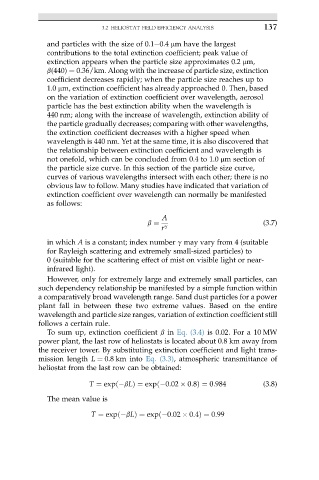
              To sum up, extinction coefficient b in Eq. (3.4) is 0.02. For a 10 MW
           power plant, the last row of heliostats is located about 0.8 km away from
           the receiver tower. By substituting extinction coefficient and light trans-
           mission length L ¼ 0.8 km into Eq. (3.3), atmospheric transmittance of
           heliostat from the last row can be obtained:
                         T ¼ expð bLÞ¼ expð 0:02   0:8Þ¼ 0:984          (3.8)

              The mean value is
                          T ¼ expð bLÞ¼ expð 0:02   0:4Þ¼ 0:99

