


Page 147 - Design of Solar Thermal Power Plants
P. 147
132         3. GENERAL DESIGN OF A SOLAR THERMAL POWER PLANT

               In addition, as the scattering effect of blue light is the strongest, a
               clear sky is normally blue-colored.
            3. Attenuation of atmospheric aerosols. Definition of atmospheric
               aerosols: There is a large amount of solid and liquid particles in
               the atmosphere with the size between 0.001 and 10 mm. They are
               mostly dusts, soot deposits, water droplets, sized salts, organic
               microbes, etc. As they are suspended in a gel state in the
               atmosphere, these particles are normally called atmospheric
               aerosols. As a major factor for influencing climate change,
               atmospheric aerosols have aroused widespread attention from the
               world scientific circle, which mainly include six categories of seven
               types of aerosol particles. Sand dust aerosols or so-called mineral
               aerosols are the main components of troposphere aerosols. China’s
               sand dust aerosols mainly come from deserts in Xinjiang, Gansu,
               Inner Mongolia, Loess Plateau and other arid and semiarid areas.
               Recently, frequent sandstorms in North China have aroused broad
               attention from both home and abroad. Sandstorm has turned into a
               major environmental problem of the Earth. Sizes of atmospheric
               aerosol particles are distributed on a very complex basis, and are
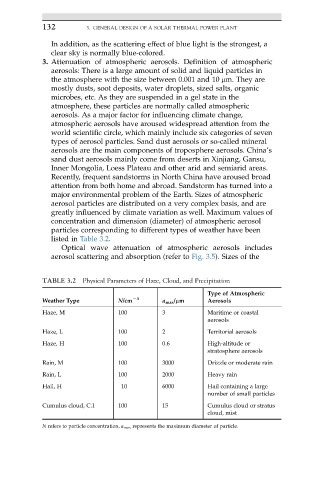
               greatly influenced by climate variation as well. Maximum values of
               concentration and dimension (diameter) of atmospheric aerosol
               particles corresponding to different types of weather have been
               listed in Table 3.2.
                  Optical wave attenuation of atmospheric aerosols includes
               aerosol scattering and absorption (refer to Fig. 3.5). Sizes of the


            TABLE 3.2 Physical Parameters of Haze, Cloud, and Precipitation

                                                         Type of Atmospheric
                                     L3
            Weather Type         N/cm        a max /mm   Aerosols
            Haze, M              100         3           Maritime or coastal
                                                         aerosols
            Haze, L              100         2           Territorial aerosols
            Haze, H              100         0.6         High-altitude or
                                                         stratosphere aerosols
            Rain, M              100         3000        Drizzle or moderate rain
            Rain, L              100         2000        Heavy rain
            Hail, H               10         6000        Hail containing a large
                                                         number of small particles
            Cumulus cloud, C.1   100         15          Cumulus cloud or stratus
                                                         cloud, mist

            N refers to particle concentration, a max represents the maximum diameter of particle.

