


Page 154 - Design of Solar Thermal Power Plants
P. 154
3.2 HELIOSTAT FIELD EFFICIENCY ANALYSIS    139

           porous materials. Solar radiation is transmitted and absorbed within the
           entire volume of absorber, which is frequently used together with the
           system that uses heat-transfer fluid as the gas. The tubular receiver consists
           of several pieces of tubes. Solar radiation will be absorbed on the surface of
           the absorber tube; interior wall of the tube exchanges thermal energy with
           the heat-transfer fluid flowing through the tube by the convection heat
           transfer, the heat-transfer medium of which is liquid in most of the cases.
              For a cavity receiver, the heat loss P LOSS can be calculated as follows [21]

                                                                        (3.9)
                        P LOSS ¼ P REFCAV þ P RAD þ P CONV þ P COND
           in which P REFCAV refers to the reflective radiation loss of the cavity
           receiver; P RAD refers to the radiation heat loss from the surface of absorber
           inside the cavity receiver to the outside through receiver aperture; P CONV
           refers to the thermal convection from the surface of absorber to the
           outside through receiver aperture; P COND refers to the conductive heat
           loss from the surface of absorber to the outside heat loss.
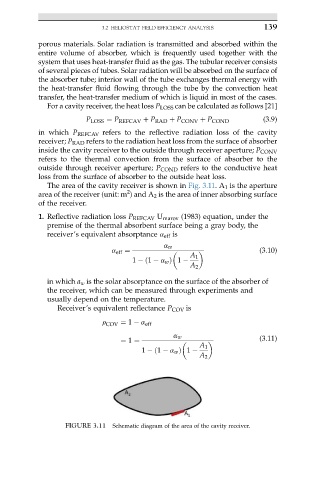
              The area of the cavity receiver is shown in Fig. 3.11.A 1 is the aperture
                                   2
           area of the receiver (unit: m ) and A 2 is the area of inner absorbing surface
           of the receiver.
           1. Reflective radiation loss P REFCAV U marov (1983) equation, under the
              premise of the thermal absorbent surface being a gray body, the
              receiver’s equivalent absorptance a eff is
                                             a w
                               a eff ¼                                 (3.10)
                                                    A 1
                                     1  ð1   a w Þ 1
                                                    A 2
              in which a w is the solar absorptance on the surface of the absorber of
              the receiver, which can be measured through experiments and
              usually depend on the temperature.
                 Receiver’s equivalent reflectance P COV is
                             r COV  ¼ 1   a eff
                                                a w
                                  ¼ 1 ¼                                (3.11)
                                                       A 1
                                       1   ð1   a w Þ 1
                                                       A 2


                   FIGURE 3.11  Schematic diagram of the area of the cavity receiver.

