


Page 159 - Design of Solar Thermal Power Plants
P. 159
144         3. GENERAL DESIGN OF A SOLAR THERMAL POWER PLANT

               aperture (refer to Fig. 3.16); G r is the Grashof number; Nu is the
               Nusselt number.
                  In case that the receiver is placed horizontally, q ¼ 0, the
               respective Nusselt number is Nu 0 .
                  Nusselt numbers corresponding to other dip angles and the
               respective ratios are:
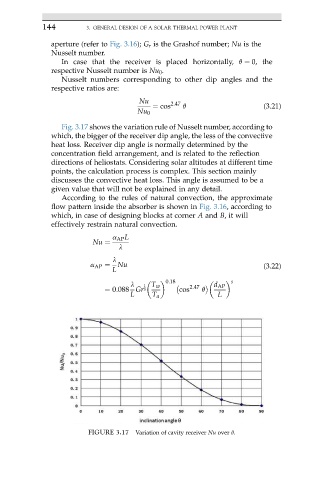
                                       Nu      2:47
                                          ¼ cos   q                     (3.21)
                                      Nu 0
                  Fig. 3.17 shows the variation rule of Nusselt number, according to
               which, the bigger of the receiver dip angle, the less of the convective
               heat loss. Receiver dip angle is normally determined by the
               concentration field arrangement, and is related to the reflection
               directions of heliostats. Considering solar altitudes at different time
               points, the calculation process is complex. This section mainly
               discusses the convective heat loss. This angle is assumed to be a
               given value that will not be explained in any detail.
                  According to the rules of natural convection, the approximate
               flow pattern inside the absorber is shown in Fig. 3.16, according to
               which, in case of designing blocks at corner A and B, it will
               effectively restrain natural convection.

                               a AP L
                          Nu ¼
                                 l
                               l
                         a AP ¼ Nu                                      (3.22)
                               L
                                              0:18              s


                                    l   1 T w       2:47    d AP
                             ¼ 0:088 Gr 3        cos    q
                                    L     T a               L


                         FIGURE 3.17  Variation of cavity receiver Nu over q.

