


Page 158 - Design of Solar Thermal Power Plants
P. 158
3.2 HELIOSTAT FIELD EFFICIENCY ANALYSIS    143

                 After measuring the absorber surface temperature T w ,by
              substituting Eq. (3.16) into Eq. (3.15), formula for calculating
              radiation heat loss of receiver can be easily obtained.

                                              4
                                        ε w s T   T 4 g  A 1
                                             w
                              P RAD ¼                                  (3.18)
                                                     A 2
                                      1  ð1   ε w Þ 1
                                                     A 1
           3. Convective heat loss P conv . Convective heat losses of receiver include
              natural convective heat loss and forced convective heat loss. The
              forced convective heat loss will not be explained in this section at
              this moment, only the method for calculating natural convective
              heat loss will be discussed. Driven by buoyance, natural convection
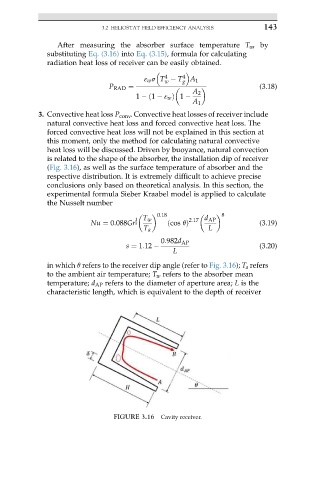
              is related to the shape of the absorber, the installation dip of receiver
              (Fig. 3.16), as well as the surface temperature of absorber and the
              respective distribution. It is extremely difficult to achieve precise
              conclusions only based on theoretical analysis. In this section, the
              experimental formula Sieber Kraabel model is applied to calculate
              the Nusselt number
                                            0:18             8
                                      1 T w         2:17  d AP
                          Nu ¼ 0:088Gr 2      ðcos qÞ                  (3.19)
                                        T a              L
                                            0:982d AP
                                   s ¼ 1:12                            (3.20)
                                                L
              in which q refers to the receiver dip angle (refer to Fig. 3.16); T a refers
              to the ambient air temperature; T w refers to the absorber mean
              temperature; d AP refers to the diameter of aperture area; L is the
              characteristic length, which is equivalent to the depth of receiver


                                FIGURE 3.16  Cavity receiver.

