


Page 175 - Design of Solar Thermal Power Plants
P. 175
160         3. GENERAL DESIGN OF A SOLAR THERMAL POWER PLANT

               This testing standard offers the specific measurement operation
            process and calculation procedures, and separately determines thermal
            efficiencies at the aperture of receiver of parabolic trough collector under
            near-vertical incidence of solar radiation corresponding to different inlet
            temperatures of heat-transfer fluid within the collector, and optical
            responses of parabolic trough collector corresponding to different solar
            incidence angles. In order to make sure that calculation results are
            compared in accordance with the unified standard, thermal efficiency on
            the basis of the aperture area of parabolic trough collectors in ASHRAE 93
            has been applied in this section for the regression of steady state
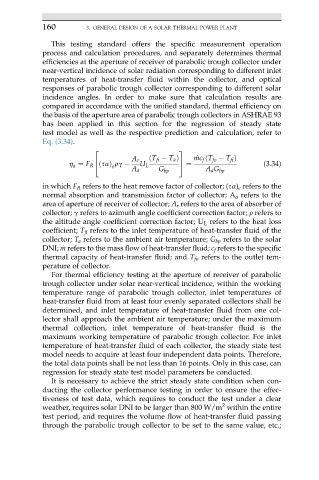
            test model as well as the respective prediction and calculation, refer to
            Eq. (3.34).

                          2                      3
                                     A r  ðT fi   T a Þ  _ mc f ðT fo   T fi Þ
                    h ¼ F R ðsaÞ rg    U L       5  ¼                   (3.34)
                     a
                               e
                          4
                                     A a    G bp         A a G bp
            in which F R refers to the heat remove factor of collector; (sa) e refers to the
            normal absorption and transmission factor of collector; A a refers to the
            area of aperture of receiver of collector; A r refers to the area of absorber of
            collector; g refers to azimuth angle coefficient correction factor; r refers to
            the altitude angle coefficient correction factor; U L refers to the heat loss
            coefficient; T fi refers to the inlet temperature of heat-transfer fluid of the
            collector; T a refers to the ambient air temperature; G bp refers to the solar
            DNI; _ m refers to the mass flow of heat-transfer fluid; c f refers to the specific
            thermal capacity of heat-transfer fluid; and T fo refers to the outlet tem-
            perature of collector.
               For thermal efficiency testing at the aperture of receiver of parabolic
            trough collector under solar near-vertical incidence, within the working
            temperature range of parabolic trough collector, inlet temperatures of
            heat-transfer fluid from at least four evenly separated collectors shall be
            determined, and inlet temperature of heat-transfer fluid from one col-
            lector shall approach the ambient air temperature; under the maximum
            thermal collection, inlet temperature of heat-transfer fluid is the
            maximum working temperature of parabolic trough collector. For inlet
            temperature of heat-transfer fluid of each collector, the steady state test
            model needs to acquire at least four independent data points. Therefore,
            the total data points shall be not less than 16 points. Only in this case, can
            regression for steady state test model parameters be conducted.
               It is necessary to achieve the strict steady state condition when con-
            ducting the collector performance testing in order to ensure the effec-
            tiveness of test data, which requires to conduct the test under a clear
                                                             2
            weather, requires solar DNI to be larger than 800 W/m within the entire
            test period, and requires the volume flow of heat-transfer fluid passing
            through the parabolic trough collector to be set to the same value, etc.;

