


Page 177 - Design of Solar Thermal Power Plants
P. 177
162         3. GENERAL DESIGN OF A SOLAR THERMAL POWER PLANT

               Nevertheless, for a large-scale parabolic trough solar collector in actual
            operation, the respective length has determined that it cannot be placed
            on a biaxial rotation tracking test platform, which means, the condition of
            near-vertical incident of solar radiation on the daylight surface of para-
            bolic trough collector is basically unfulfillable; in addition, testing for the
            IAM also cannot be conducted. In the case that the parabolic trough
            collector is arranged horizontally along the north-south axis, condition of
            near-vertical incident of solar radiation on the daylight surface of para-
            bolic trough collector only occurs once in the morning and once at night
            every day; yet at this moment, it happens to depend on fluctuation of
            increase or decrease of solar DNI, even under such circumstances, it
            cannot be ensured that it may occur at any given time throughout the
            year; instead, it depends on the latitude of the test site. In the case that the
            parabolic trough collector is arranged horizontally along the west-east
            axis, only around midday can incidence of solar radiation along the
            normal direction near the daylight surface of a parabolic trough collector
            occur.
               Besides, analytic results have indicated that when parabolic trough
            collectors are subject to the typical intermittent heat-transfer fluid tem-
            perature variation in the heating process under cloudy conditions, the
            steady state test model is ineffective. Therefore, the steady state test
            duration may be extended by these adverse natural environment and
            operating conditions, especially for test sites with less favorable natural
            environmental conditions.

            3.3.2.3 Brief Introduction to the EN 12975-2 Quasi-Dynamic
            Test Method
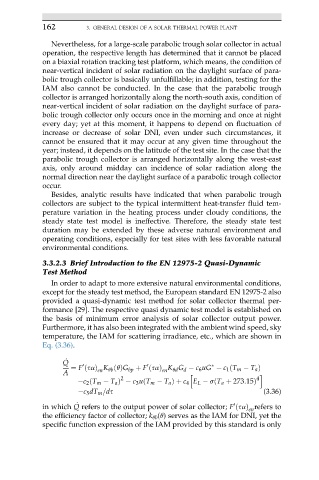
               In order to adapt to more extensive natural environmental conditions,
            except for the steady test method, the European standard EN 12975-2 also
            provided a quasi-dynamic test method for solar collector thermal per-
            formance [29]. The respective quasi dynamic test model is established on
            the basis of minimum error analysis of solar collector output power.
            Furthermore, it has also been integrated with the ambient wind speed, sky
            temperature, the IAM for scattering irradiance, etc., which are shown in
            Eq. (3.36).

                  Q _

                                         0
                       0
                    ¼ F ðsaÞ K qb ðqÞG bp þ F ðsaÞ K qd G d   c 6 uG   c 1 ðT m   T a Þ
                                             en
                           en
                  A
                                                    h                  i
                                  2                                   4
                       c 2 ðT m   T a Þ   c 3 uðT m   T a Þþ c 4 E L   sðT a þ 273:15Þ
                       c 5 dT m =ds                                     (3.36)
                      _
            in which Q refers to the output power of solar collector; F ðsaÞ refers to
                                                                0
                                                                    en
            the efficiency factor of collector; k qb (q) serves as the IAM for DNI, yet the
            specific function expression of the IAM provided by this standard is only

