


Page 180 - Design of Solar Thermal Power Plants
P. 180
3.3 THERMAL PERFORMANCE OF PARABOLIC TROUGH COLLECTOR  165

           collector through a single inlet and flows out through a single outlet.
           Apparently, the parabolic trough solar collector is influenced by the scope
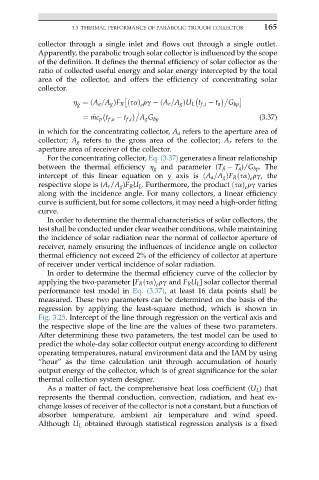
           of the definition. It defines the thermal efficiency of solar collector as the
           ratio of collected useful energy and solar energy intercepted by the total
           area of the collector, and offers the efficiency of concentrating solar
           collector.


                     h ¼ðA a =A g ÞF R ðsaÞ rg  ðA r =A g ÞU L t f;i    t a  G bp
                      g
                                       e

                       ¼ _ mc p t f;o    t f;i  A g G bp               (3.37)
           in which for the concentrating collector, A a refers to the aperture area of
           collector; A g refers to the gross area of the collector; A r refers to the
           aperture area of receiver of the collector.
              For the concentrating collector, Eq. (3.37) generates a linear relationship
           between the thermal efficiency h g and parameter (T fi   T a )/G bp . The
           intercept of this linear equation on y axis is ðA a =A g ÞF R ðsaÞ rg, the
                                                                     e
           respective slope is (A r /A g )F R U L . Furthermore, the product ðsaÞ rg varies
                                                                   e
           along with the incidence angle. For many collectors, a linear efficiency
           curve is sufficient, but for some collectors, it may need a high-order fitting
           curve.
              In order to determine the thermal characteristics of solar collectors, the
           test shall be conducted under clear weather conditions, while maintaining
           the incidence of solar radiation near the normal of collector aperture of
           receiver, namely ensuring the influences of incidence angle on collector
           thermal efficiency not exceed 2% of the efficiency of collector at aperture
           of receiver under vertical incidence of solar radiation.
              In order to determine the thermal efficiency curve of the collector by
           applying the two-parameter [F R ðsaÞ rg and F R U L ] solar collector thermal
                                           e
           performance test model in Eq. (3.37), at least 16 data points shall be
           measured. These two parameters can be determined on the basis of the
           regression by applying the least-square method, which is shown in
           Fig. 3.25. Intercept of the line through regression on the vertical axis and
           the respective slope of the line are the values of these two parameters.
           After determining these two parameters, the test model can be used to
           predict the whole-day solar collector output energy according to different
           operating temperatures, natural environment data and the IAM by using
           “hour” as the time calculation unit through accumulation of hourly
           output energy of the collector, which is of great significance for the solar
           thermal collection system designer.
              As a matter of fact, the comprehensive heat loss coefficient (U L ) that
           represents the thermal conduction, convection, radiation, and heat ex-
           change losses of receiver of the collector is not a constant, but a function of
           absorber temperature, ambient air temperature and wind speed.
           Although U L obtained through statistical regression analysis is a fixed

