


Page 185 - Design of Solar Thermal Power Plants
P. 185
170         3. GENERAL DESIGN OF A SOLAR THERMAL POWER PLANT

            heat-transfer fluid; T a refers to the ambient air temperature; A a refers to
            the aperture area of parabolic trough collector; A f refers to the heat
            exchange area between metal evacuated tube and heat-transfer fluid; A am
            refers to the heat exchange area between metal evacuated tube and the
            environment; U bf refers to the heat-transfer coefficient between metal tube
            and heat-transfer fluid; U ba refers to the comprehensive heat-transfer
            coefficient between metal evacuated tube and the environment; srefers
            to time; S refers to the part absorbed by the exterior wall surface of metal
            evacuated tube when solar DNI is perpendicular to the aperture of
            parabolic trough collector. The last one to the right of the equation is to
            express the heat exchange process between metal evacuated tube and the
            neighboring environment, which is normally within the glazed shield
            tube.
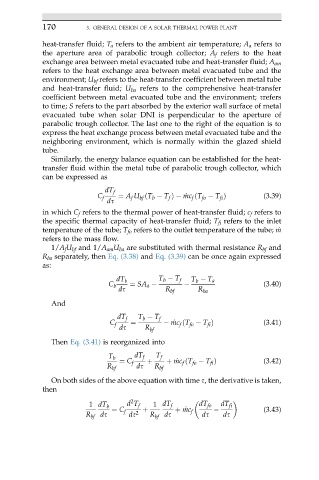
               Similarly, the energy balance equation can be established for the heat-
            transfer fluid within the metal tube of parabolic trough collector, which
            can be expressed as

                             dT f
                           C f  ds  ¼ A U ðT   T Þ  _ mc ðT   T Þ       (3.39)
                                               f
                                          b
                                    f
                                       bf
                                                            fi
                                                        fo
                                                     f
            in which C f refers to the thermal power of heat-transfer fluid; c f refers to
            the specific thermal capacity of heat-transfer fluid; T fi refers to the inlet
            temperature of the tube; T fo refers to the outlet temperature of the tube; _ m
            refers to the mass flow.
               1/A f U bf and 1/A am U ba are substituted with thermal resistance R bf and
            R ba separately, then Eq. (3.38) and Eq. (3.39) can be once again expressed
            as:
                                            T   T
                                dT b         b    f  T b   T a
                              C b  ds  ¼ SA a    R bf     R ba          (3.40)
               And
                                 dT f  T b   T f
                               C f  ¼          _ mc f ðT fo   T fi Þ    (3.41)
                                 ds     R bf
               Then Eq. (3.41) is reorganized into

                              T b    dT f  T f
                                 ¼ C f   þ    þ _ mc f ðT fo   T fi Þ   (3.42)
                              R bf    ds   R bf
               On both sides of the above equation with time s, the derivative is taken,
            then
                                    2
                         1 dT b    d T f  1 dT f       dT fo  dT fi
                               ¼ C f    þ       þ _ mc f                (3.43)
                        R bf  ds    ds 2  R bf  ds      ds   ds

