


Page 187 - Design of Solar Thermal Power Plants
P. 187
172 3. GENERAL DESIGN OF A SOLAR THERMAL POWER PLANT
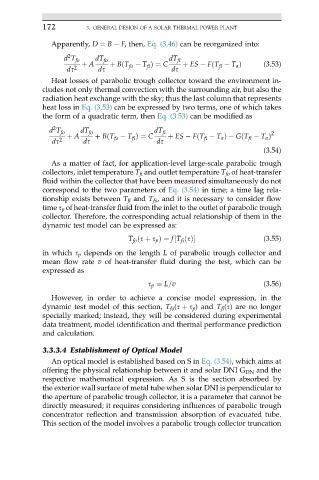
Apparently, D ¼ B e F, then, Eq. (3.46) can be reorganized into:
2
d T fo dT fo dT fi
þ A þ BðT fo T fi ¼ C þ ES FðT fi T a Þ (3.53)
Þ
ds 2 ds ds
Heat losses of parabolic trough collector toward the environment in-
cludes not only thermal convection with the surrounding air, but also the
radiation heat exchange with the sky; thus the last column that represents
heat loss in Eq. (3.53) can be expressed by two terms, one of which takes
the form of a quadratic term, then Eq. (3.53) can be modified as
2
d T fo dT fo dT fi 2
þ A þ BðT fo T fi Þ¼ C þ ES FðT fi T a Þ GðT fi T a Þ
ds 2 ds ds
(3.54)
As a matter of fact, for application-level large-scale parabolic trough
collectors, inlet temperature T fi and outlet temperature T fo of heat-transfer
fluid within the collector that have been measured simultaneously do not
correspond to the two parameters of Eq. (3.54) in time; a time lag rela-
tionship exists between T fi and T fo , and it is necessary to consider flow
time s p of heat-transfer fluid from the inlet to the outlet of parabolic trough
collector. Therefore, the corresponding actual relationship of them in the
dynamic test model can be expressed as:
T fo ðs þ s p Þ¼ f½T fi ðsÞ (3.55)
in which s p depends on the length L of parabolic trough collector and
mean flow rate v of heat-transfer fluid during the test, which can be
expressed as
s p ¼ L=v (3.56)
However, in order to achieve a concise model expression, in the
dynamic test model of this section, T fo (s þ s p ) and T fi (s) are no longer
specially marked; instead, they will be considered during experimental
data treatment, model identification and thermal performance prediction
and calculation.
3.3.3.4 Establishment of Optical Model
An optical model is established based on S in Eq. (3.54), which aims at
offering the physical relationship between it and solar DNI G DN and the
respective mathematical expression. As S is the section absorbed by
the exterior wall surface of metal tube when solar DNI is perpendicular to
the aperture of parabolic trough collector, it is a parameter that cannot be
directly measured; it requires considering influences of parabolic trough
concentrator reflection and transmission absorption of evacuated tube.
This section of the model involves a parabolic trough collector truncation

