


Page 192 - Design of Solar Thermal Power Plants
P. 192
3.3 THERMAL PERFORMANCE OF PARABOLIC TROUGH COLLECTOR  177

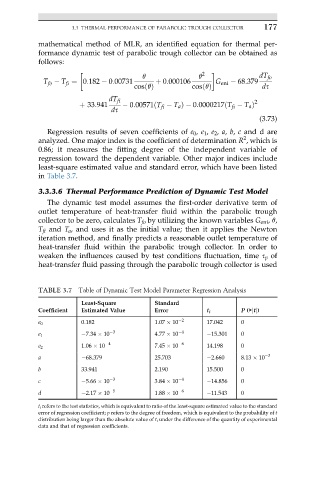
           mathematical method of MLR, an identified equation for thermal per-
           formance dynamic test of parabolic trough collector can be obtained as
           follows:
                                       q               q               dT fo
                                                        2
             T fo   T fi ¼ 0:182   0:00731  þ 0:000106     G eni   68:379
                                     cosðqÞ          cosðqÞ             ds
                              dT fi                                   2
                      þ 33:941      0:00571ðT   T a Þ  0:0000217ðT   T a Þ
                                                                fi
                                             fi
                               ds
                                                                       (3.73)
              Regression results of seven coefficients of e 0 , e 1 , e 2 , a, b, c and d are
                                                                   2
           analyzed. One major index is the coefficient of determination R , which is
           0.86; it measures the fitting degree of the independent variable of
           regression toward the dependent variable. Other major indices include
           least-square estimated value and standard error, which have been listed
           in Table 3.7.

           3.3.3.6 Thermal Performance Prediction of Dynamic Test Model
              The dynamic test model assumes the first-order derivative term of
           outlet temperature of heat-transfer fluid within the parabolic trough
           collector to be zero, calculates T fo by utilizing the known variables G eni , q,
           T fi and T a , and uses it as the initial value; then it applies the Newton
           iteration method, and finally predicts a reasonable outlet temperature of
           heat-transfer fluid within the parabolic trough collector. In order to
           weaken the influences caused by test conditions fluctuation, time s p of
           heat-transfer fluid passing through the parabolic trough collector is used


           TABLE 3.7 Table of Dynamic Test Model Parameter Regression Analysis


                       Least-Square        Standard
           Coefficient  Estimated Value     Error         t i      P (>jtj)
                       0.182               1.07   10  2  17.042   0
           e 0
                        7.34   10  3       4.77   10  4   15.301  0
           e 1
                       1.06   10  4        7.45   10  6  14.198   0
           e 2
           a            68.379             25.703         2.660   8.13   10  3
           b           33.941              2.190         15.500   0
           c            5.66   10  3       3.84   10  4   14.856  0
           d            2.17   10  5       1.88   10  6   11.543  0
           t i refers to the test statistics, which is equivalent to ratio of the least-square estimated value to the standard
           error of regression coefficient; p refers to the degree of freedom, which is equivalent to the probability of t
           distribution being larger than the absolute value of t i under the difference of the quantity of experimental
           data and that of regression coefficients.

