


Page 197 - Design of Solar Thermal Power Plants
P. 197
182         3. GENERAL DESIGN OF A SOLAR THERMAL POWER PLANT

            trough collector, most of the data coincide with each other. This is because
            an undetermined coefficient of dynamic test model has been obtained
            through regression of this group of experimental data.


            3.3.5 Experimental Condition II
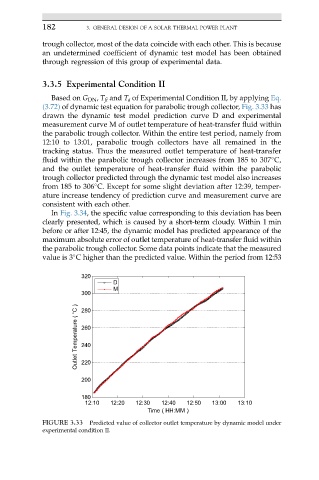
               Based on G DN , T fi and T a of Experimental Condition II, by applying Eq.
            (3.72) of dynamic test equation for parabolic trough collector, Fig. 3.33 has
            drawn the dynamic test model prediction curve D and experimental
            measurement curve M of outlet temperature of heat-transfer fluid within
            the parabolic trough collector. Within the entire test period, namely from
            12:10 to 13:01, parabolic trough collectors have all remained in the
            tracking status. Thus the measured outlet temperature of heat-transfer

            fluid within the parabolic trough collector increases from 185 to 307 C,
            and the outlet temperature of heat-transfer fluid within the parabolic
            trough collector predicted through the dynamic test model also increases

            from 185 to 306 C. Except for some slight deviation after 12:39, temper-
            ature increase tendency of prediction curve and measurement curve are
            consistent with each other.
               In Fig. 3.34, the specific value corresponding to this deviation has been
            clearly presented, which is caused by a short-term cloudy. Within 1 min
            before or after 12:45, the dynamic model has predicted appearance of the
            maximum absolute error of outlet temperature of heat-transfer fluid within
            the parabolic trough collector. Some data points indicate that the measured
            value is 3 C higher than the predicted value. Within the period from 12:53

                       320
                                D
                                M
                       300
                      Outlet Temperature ( °C )  260
                       280


                       240

                       220

                       200

                       180
                        12:10  12:20  12:30  12:40  12:50  13:00  13:10
                                         Time ( HH:MM )
            FIGURE 3.33  Predicted value of collector outlet temperature by dynamic model under
            experimental condition II.

