


Page 194 - Design of Solar Thermal Power Plants
P. 194
3.3 THERMAL PERFORMANCE OF PARABOLIC TROUGH COLLECTOR  179

              In order to simplify the calculation, based on the observation, these
           data have high degrees of linearity. Thus according to these data, a linear
           equation can be obtained as follows through fitting method:
                                                                       (3.75)
                                 c oil ¼ 1528:32 þ 2:973T oil
           in which T oil refers to the synthetic oil temperature. In order to specify the
           reasonability and precision of this method, four typical experimental
           conditions are discussed separately as follows [30].


           3.3.4 Experimental Condition I

              Based on the meteorological data of Experimental Condition I and
           collector inlet fluid data G DN , T fi and T a , as well as the solar radiation
           incidence angle q relevant to solar position and solar irradiance G eni that
           considers cosine effect and end effect correction, predicted value of fluid
           outlet temperature of parabolic trough collector can be obtained through
           iteration calculation by applying Eq. (3.72).
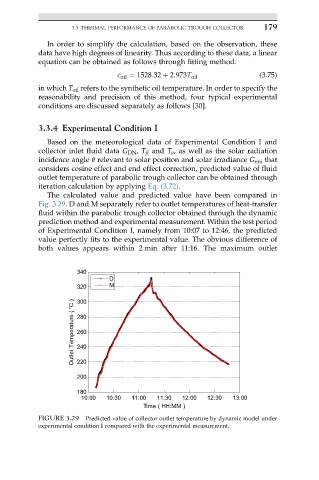
              The calculated value and predicted value have been compared in
           Fig. 3.29. D and M separately refer to outlet temperatures of heat-transfer
           fluid within the parabolic trough collector obtained through the dynamic
           prediction method and experimental measurement. Within the test period
           of Experimental Condition I, namely from 10:07 to 12:46, the predicted
           value perfectly fits to the experimental value. The obvious difference of
           both values appears within 2 min after 11:16. The maximum outlet


                      340
                               D
                      320      M
                     Outlet Temperature ( °C )  280
                      300


                      260
                      240

                      220
                      200

                      180
                       10:00  10:30  11:00  11:30  12:00  12:30  13:00
                                        Time ( HH:MM )
           FIGURE 3.29  Predicted value of collector outlet temperature by dynamic model under
           experimental condition I compared with the experimental measurement.

