


Page 193 - Design of Solar Thermal Power Plants
P. 193
178         3. GENERAL DESIGN OF A SOLAR THERMAL POWER PLANT

            as the reference when implementing smoothing processing toward
            the predicted outlet temperature data of heat-transfer fluid within the
            parabolic trough collector.
               In order to clearly express the prediction results, difference between
            the measured and the predicted outlet temperatures of heat-transfer fluid
            within the parabolic trough collector is offered as the absolute error, and
            used to divide the measured outlet temperature of heat-transfer fluid
            within the parabolic trough collector in order to obtain the ratio that can
            be used as the relative error of prediction results.
               Furthermore, in order to demonstrate the working effect of the
            collector, it is also necessary to calculate the collector efficiency,
            which refers to the ratio of the output energy from parabolic trough
            collector to the solar DNI projected into the concentration field dur-
            ing operation. Equation in ASHRAE 93 standard is applied in this
            book, and solar irradiance G bp that considers the cosine effect is
            selected as the denominator of efficiency calculation equation of energy
            projected into the concentration field, which is shown in Eq. (3.74).
            There is also some literature that has only applied solar direct normal
            irradiation G DN as the denominator of the efficiency equation without
            considering the influence of cosine loss.

                                           _
                                       R
                                        c oil mðT fo   T fi Þds
                                   h ¼      R                           (3.74)
                                          A a G bp ds
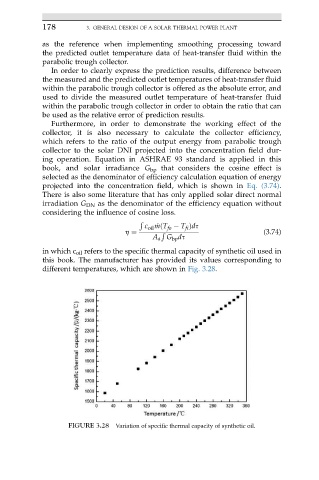
            in which c oil refers to the specific thermal capacity of synthetic oil used in
            this book. The manufacturer has provided its values corresponding to
            different temperatures, which are shown in Fig. 3.28.


                    FIGURE 3.28  Variation of specific thermal capacity of synthetic oil.

