


Page 200 - Design of Solar Thermal Power Plants
P. 200
3.3 THERMAL PERFORMANCE OF PARABOLIC TROUGH COLLECTOR  185

           3.3.6 Experimental Condition III
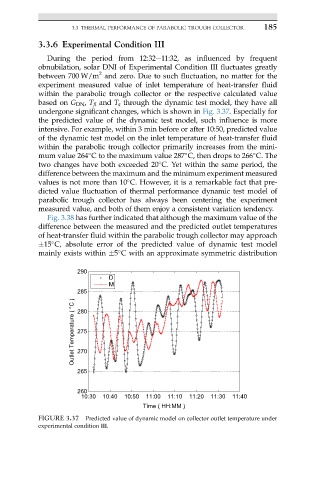
              During the period from 12:32e11:32, as influenced by frequent
           obnubilation, solar DNI of Experimental Condition III fluctuates greatly
                            2
           between 700 W/m and zero. Due to such fluctuation, no matter for the
           experiment measured value of inlet temperature of heat-transfer fluid
           within the parabolic trough collector or the respective calculated value
           based on G DN , T fi and T a through the dynamic test model, they have all
           undergone significant changes, which is shown in Fig. 3.37. Especially for
           the predicted value of the dynamic test model, such influence is more
           intensive. For example, within 3 min before or after 10:50, predicted value
           of the dynamic test model on the inlet temperature of heat-transfer fluid
           within the parabolic trough collector primarily increases from the mini-


           mum value 264 C to the maximum value 287 C, then drops to 266 C. The

           two changes have both exceeded 20 C. Yet within the same period, the

           difference between the maximum and the minimum experiment measured

           values is not more than 10 C. However, it is a remarkable fact that pre-
           dicted value fluctuation of thermal performance dynamic test model of
           parabolic trough collector has always been centering the experiment
           measured value, and both of them enjoy a consistent variation tendency.
              Fig. 3.38 has further indicated that although the maximum value of the
           difference between the measured and the predicted outlet temperatures
           of heat-transfer fluid within the parabolic trough collector may approach
            15 C, absolute error of the predicted value of dynamic test model


           mainly exists within  5 C with an approximate symmetric distribution
                      290
                              D
                              M
                      285
                     Outlet Temperature ( °C )  275
                      280


                      270

                      265


                      260
                       10:30  10:40  10:50  11:00  11:10  11:20  11:30  11:40
                                        Time ( HH:MM )
           FIGURE 3.37  Predicted value of dynamic model on collector outlet temperature under
           experimental condition III.

