


Page 246 - Design of Solar Thermal Power Plants
P. 246
4.2 PRINCIPLES FOR CONCENTRATION FIELD LAYOUT  229

                        0° Mean value  45° Mean value  90° Mean value  180° Mean value
              100
              90
             Mean reflectivity /%  70
              80
              60
              50
              40
              30
              20
              10
                               Nov. 26 th , 2011
             Aug. 28 th , 2011 Sept. 27 th , 2011 Oct. 12 th , 2011 Oct. 27 th , 2011 Nov. 11 th , 2011  Dec. 11 th , 2011 Dec. 26 th , 2011 Jan. 10 th , 2012 Jan. 25 th , 2012 Feb. 9 th , 2012 Feb. 24 th , 2012 Mar. 10 th , 2012 Mar. 25 th , 2012 Apr. 9 th , 2012 Apr. 24 th , 2012 May 9 th , 2012 May 24 th , 2012  Date
               Sept. 12 th , 2011

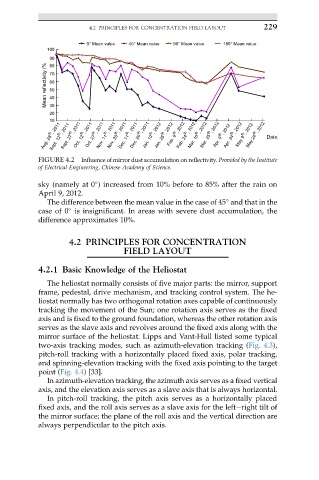
           FIGURE 4.2  Influence of mirror dust accumulation on reflectivity. Provided by the Institute
           of Electrical Engineering, Chinese Academy of Science.

           sky (namely at 0 ) increased from 10% before to 85% after the rain on

           April 9, 2012.

              The difference between the mean value in the case of 45 and that in the

           case of 0 is insignificant. In areas with severe dust accumulation, the
           difference approximates 10%.
                    4.2 PRINCIPLES FOR CONCENTRATION
                                   FIELD LAYOUT

           4.2.1 Basic Knowledge of the Heliostat
              The heliostat normally consists of five major parts: the mirror, support
           frame, pedestal, drive mechanism, and tracking control system. The he-
           liostat normally has two orthogonal rotation axes capable of continuously
           tracking the movement of the Sun; one rotation axis serves as the fixed
           axis and is fixed to the ground foundation, whereas the other rotation axis
           serves as the slave axis and revolves around the fixed axis along with the
           mirror surface of the heliostat. Lipps and Vant-Hull listed some typical
           two-axis tracking modes, such as azimuth-elevation tracking (Fig. 4.3),
           pitch-roll tracking with a horizontally placed fixed axis, polar tracking,
           and spinning-elevation tracking with the fixed axis pointing to the target
           point (Fig. 4.4) [33].
              In azimuth-elevation tracking, the azimuth axis serves as a fixed vertical
           axis, and the elevation axis serves as a slave axis that is always horizontal.
              In pitch-roll tracking, the pitch axis serves as a horizontally placed
           fixed axis, and the roll axis serves as a slave axis for the lefteright tilt of
           the mirror surface; the plane of the roll axis and the vertical direction are
           always perpendicular to the pitch axis.

