


Page 248 - Design of Solar Thermal Power Plants
P. 248
4.2 PRINCIPLES FOR CONCENTRATION FIELD LAYOUT  231

           perpendicular to the spin axis (Fig. 4.4). The elevation axis is fixed along
           the sagittal direction of the mirror surface on the support frame of the
           heliostat and revolves around the spinning axis together with the frame
           and the mirror surface.
              The azimuth-elevation tracking mode is the most common two-axis
           tracking mode and is applied by most solar trackers, parabolic solar
           dish concentrators, and heliostats. Analysis by Schramek and Mills
           concluded that compared with azimuth-elevation tracking, pitch-roll
           tracking is capable of making the heliostat field layout more compact.
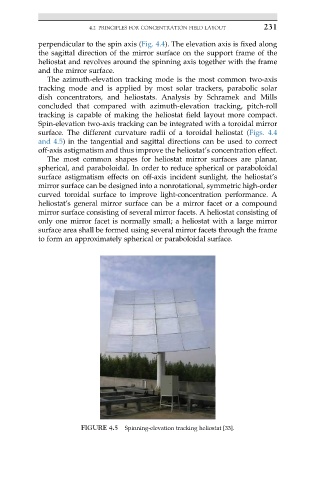
           Spin-elevation two-axis tracking can be integrated with a toroidal mirror
           surface. The different curvature radii of a toroidal heliostat (Figs. 4.4
           and 4.5) in the tangential and sagittal directions can be used to correct
           off-axis astigmatism and thus improve the heliostat’s concentration effect.
              The most common shapes for heliostat mirror surfaces are planar,
           spherical, and paraboloidal. In order to reduce spherical or paraboloidal
           surface astigmatism effects on off-axis incident sunlight, the heliostat’s
           mirror surface can be designed into a nonrotational, symmetric high-order
           curved toroidal surface to improve light-concentration performance. A
           heliostat’s general mirror surface can be a mirror facet or a compound
           mirror surface consisting of several mirror facets. A heliostat consisting of
           only one mirror facet is normally small; a heliostat with a large mirror
           surface area shall be formed using several mirror facets through the frame
           to form an approximately spherical or paraboloidal surface.


                       FIGURE 4.5  Spinning-elevation tracking heliostat [33].

