


Page 271 - Design of Solar Thermal Power Plants
P. 271
4.3 DESIGN OF THE SOLAR TOWER POWER PLANT     253


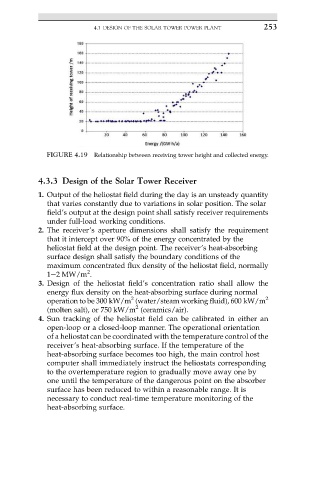
              FIGURE 4.19  Relationship between receiving tower height and collected energy.


           4.3.3 Design of the Solar Tower Receiver
           1. Output of the heliostat field during the day is an unsteady quantity
              that varies constantly due to variations in solar position. The solar
              field’s output at the design point shall satisfy receiver requirements
              under full-load working conditions.
           2. The receiver’s aperture dimensions shall satisfy the requirement
              that it intercept over 90% of the energy concentrated by the
              heliostat field at the design point. The receiver’s heat-absorbing
              surface design shall satisfy the boundary conditions of the
              maximum concentrated flux density of the heliostat field, normally
                         2
              1e2 MW/m .
           3. Design of the heliostat field’s concentration ratio shall allow the
              energy flux density on the heat-absorbing surface during normal
                                    2
              operation to be 300 kW/m (water/steam working fluid), 600 kW/m 2
                                      2
              (molten salt), or 750 kW/m (ceramics/air).
           4. Sun tracking of the heliostat field can be calibrated in either an
              open-loop or a closed-loop manner. The operational orientation
              of a heliostat can be coordinated with the temperature control of the
              receiver’s heat-absorbing surface. If the temperature of the
              heat-absorbing surface becomes too high, the main control host
              computer shall immediately instruct the heliostats corresponding
              to the overtemperature region to gradually move away one by
              one until the temperature of the dangerous point on the absorber
              surface has been reduced to within a reasonable range. It is
              necessary to conduct real-time temperature monitoring of the
              heat-absorbing surface.

