


Page 127 - Designing Autonomous Mobile Robots : Inside the Mindo f an Intellegent Machine
P. 127
Chapter 7

            require no programming, and use a variety of strategies to cover the area they are
            placed into.
            At the low end, these robots have incorporated strategies that do not represent true
            navigation, but rather movement patterns that should eventually cover the area. For
            example, lawn-mowing robots have been developed that randomly cross an area
            until they detect a boundary marker and then turn away to cross the area again.
            While most of the area is covered quickly, some areas may never be covered. The
            method is extremely inefficient.

                         TM
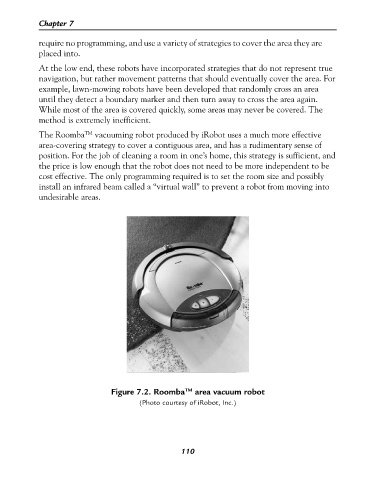
            The Roomba  vacuuming robot produced by iRobot uses a much more effective
            area-covering strategy to cover a contiguous area, and has a rudimentary sense of
            position. For the job of cleaning a room in one’s home, this strategy is sufficient, and
            the price is low enough that the robot does not need to be more independent to be
            cost effective. The only programming required is to set the room size and possibly
            install an infrared beam called a “virtual wall” to prevent a robot from moving into
            undesirable areas.


                                                    TM
                                Figure 7.2. Roomba  area vacuum robot
                                        (Photo courtesy of iRobot, Inc.)


                                                   110

