


Page 131 - Designing Autonomous Mobile Robots : Inside the Mindo f an Intellegent Machine
P. 131
Chapter 7

            Route planning by force fields

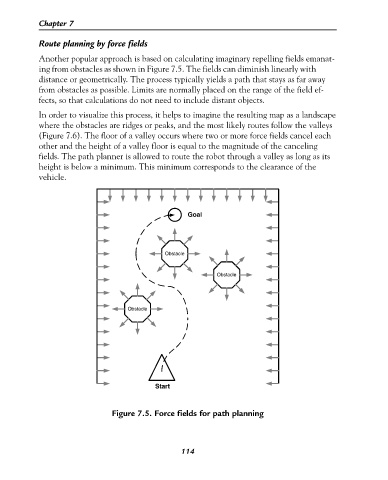
            Another popular approach is based on calculating imaginary repelling fields emanat-
            ing from obstacles as shown in Figure 7.5. The fields can diminish linearly with
            distance or geometrically. The process typically yields a path that stays as far away
            from obstacles as possible. Limits are normally placed on the range of the field ef-
            fects, so that calculations do not need to include distant objects.
            In order to visualize this process, it helps to imagine the resulting map as a landscape
            where the obstacles are ridges or peaks, and the most likely routes follow the valleys
            (Figure 7.6). The floor of a valley occurs where two or more force fields cancel each
            other and the height of a valley floor is equal to the magnitude of the canceling
            fields. The path planner is allowed to route the robot through a valley as long as its
            height is below a minimum. This minimum corresponds to the clearance of the
            vehicle.


                                                     Goal


                                               Obstacle

                                                             Obstacle


                                     Obstacle


                                            Start


                                Figure 7.5. Force fields for path planning


                                                   114

