


Page 148 - Designing Autonomous Mobile Robots : Inside the Mindo f an Intellegent Machine
P. 148
The Best Laid Plans of Mice and Machines

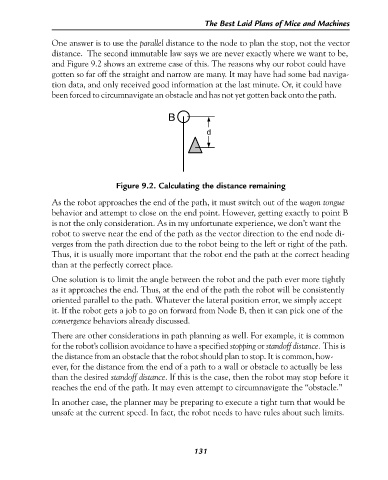
               One answer is to use the parallel distance to the node to plan the stop, not the vector
               distance.  The second immutable law says we are never exactly where we want to be,
               and Figure 9.2 shows an extreme case of this. The reasons why our robot could have
               gotten so far off the straight and narrow are many. It may have had some bad naviga-
               tion data, and only received good information at the last minute. Or, it could have
               been forced to circumnavigate an obstacle and has not yet gotten back onto the path.


                                                B
                                                          d


                                 Figure 9.2. Calculating the distance remaining
               As the robot approaches the end of the path, it must switch out of the wagon tongue
               behavior and attempt to close on the end point. However, getting exactly to point B
               is not the only consideration. As in my unfortunate experience, we don’t want the
               robot to swerve near the end of the path as the vector direction to the end node di-
               verges from the path direction due to the robot being to the left or right of the path.
               Thus, it is usually more important that the robot end the path at the correct heading
               than at the perfectly correct place.

               One solution is to limit the angle between the robot and the path ever more tightly
               as it approaches the end. Thus, at the end of the path the robot will be consistently
               oriented parallel to the path. Whatever the lateral position error, we simply accept
               it. If the robot gets a job to go on forward from Node B, then it can pick one of the
               convergence behaviors already discussed.

               There are other considerations in path planning as well. For example, it is common
               for the robot’s collision avoidance to have a specified stopping or standoff distance. This is
               the distance from an obstacle that the robot should plan to stop. It is common, how-
               ever, for the distance from the end of a path to a wall or obstacle to actually be less
               than the desired standoff distance. If this is the case, then the robot may stop before it
               reaches the end of the path. It may even attempt to circumnavigate the “obstacle.”
               In another case, the planner may be preparing to execute a tight turn that would be
               unsafe at the current speed. In fact, the robot needs to have rules about such limits.


                                                       131

