


Page 149 - Designing Autonomous Mobile Robots : Inside the Mindo f an Intellegent Machine
P. 149
Chapter 9

            Therefore, it is important to recognize that the path planner must communicate
            with other algorithms such as collision avoidance and speed control to allow the
            robot to behave intelligently in a wide range of circumstances.


            Running on

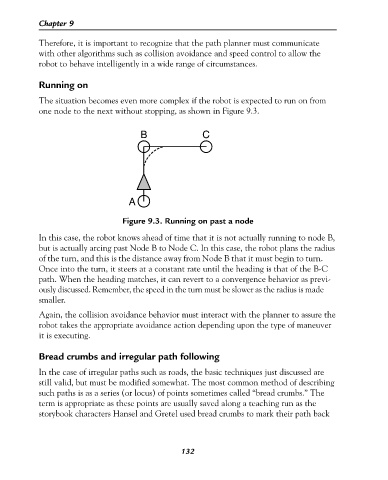
            The situation becomes even more complex if the robot is expected to run on from
            one node to the next without stopping, as shown in Figure 9.3.


                                        B                C


                                     A


                                   Figure 9.3. Running on past a node

            In this case, the robot knows ahead of time that it is not actually running to node B,
            but is actually arcing past Node B to Node C. In this case, the robot plans the radius
            of the turn, and this is the distance away from Node B that it must begin to turn.
            Once into the turn, it steers at a constant rate until the heading is that of the B-C
            path. When the heading matches, it can revert to a convergence behavior as previ-
            ously discussed. Remember, the speed in the turn must be slower as the radius is made
            smaller.

            Again, the collision avoidance behavior must interact with the planner to assure the
            robot takes the appropriate avoidance action depending upon the type of maneuver
            it is executing.

            Bread crumbs and irregular path following

            In the case of irregular paths such as roads, the basic techniques just discussed are
            still valid, but must be modified somewhat. The most common method of describing
            such paths is as a series (or locus) of points sometimes called “bread crumbs.” The
            term is appropriate as these points are usually saved along a teaching run as the
            storybook characters Hansel and Gretel used bread crumbs to mark their path back


                                                   132

