


Page 145 - Designing Autonomous Mobile Robots : Inside the Mindo f an Intellegent Machine
P. 145
Chapter 9

            The first law is due to the fact that navigation is never an exact science, and the readings
            from sensors will always contain some error. Furthermore, the robot may experience
            stretches on which it has no active navigation and is depending entirely on odometry.

            The second law is due to the fact that it is impossible to move a mass to an exact
                    1
            position . We must accept the fact that our performance will always contain some
            error, and set our goal for “good enough.”

            Path planning and execution

            There are two elements to the path-planning process itself. First, we must know the
            path we wish to travel, and secondly, we must have a strategy for getting onto and
            tracking that path. In an indoor environment, the actual paths can be composed of
            simple straight lines joined by curves. For outdoor road-following robots, on the
            other hand, paths will tend to be sequences of points that represent undulating
            curves.

            Convergence behaviors

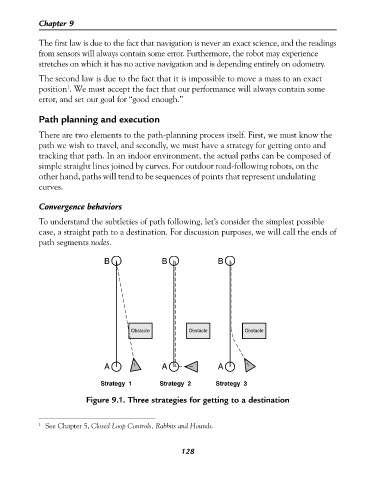
            To understand the subtleties of path following, let’s consider the simplest possible
            case, a straight path to a destination. For discussion purposes, we will call the ends of
            path segments nodes.


                              B               B               B


                                     Obstacle        Obstacle        Obstacle


                              A               A               A

                             Strategy  1     Strategy  2     Strategy  3

                         Figure 9.1. Three strategies for getting to a destination


            1  See Chapter 5, Closed Loop Controls, Rabbits and Hounds.


                                                   128

