


Page 170 - Designing Autonomous Mobile Robots : Inside the Mindo f an Intellegent Machine
P. 170
Hard Navigation vs. Fuzzy Navigation

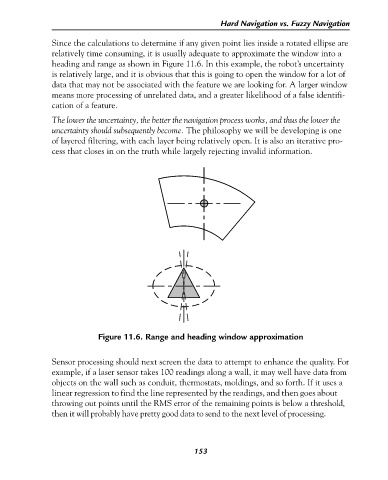
               Since the calculations to determine if any given point lies inside a rotated ellipse are
               relatively time consuming, it is usually adequate to approximate the window into a
               heading and range as shown in Figure 11.6. In this example, the robot’s uncertainty
               is relatively large, and it is obvious that this is going to open the window for a lot of
               data that may not be associated with the feature we are looking for. A larger window
               means more processing of unrelated data, and a greater likelihood of a false identifi-
               cation of a feature.
               The lower the uncertainty, the better the navigation process works, and thus the lower the
               uncertainty should subsequently become. The philosophy we will be developing is one
               of layered filtering, with each layer being relatively open. It is also an iterative pro-
               cess that closes in on the truth while largely rejecting invalid information.


                            Figure 11.6. Range and heading window approximation


               Sensor processing should next screen the data to attempt to enhance the quality. For
               example, if a laser sensor takes 100 readings along a wall, it may well have data from
               objects on the wall such as conduit, thermostats, moldings, and so forth. If it uses a
               linear regression to find the line represented by the readings, and then goes about
               throwing out points until the RMS error of the remaining points is below a threshold,
               then it will probably have pretty good data to send to the next level of processing.


                                                       153

