


Page 193 - Designing Autonomous Mobile Robots : Inside the Mindo f an Intellegent Machine
P. 193
Chapter 12

            Fixed light beams

            The availability of affordable lidar has reduced the interest in fixed light beam sys-
            tems, but they can still play a part in low-cost systems, or as adjuncts to collision avoid-
            ance systems in robots. Very inexpensive fixed-beam ranging modules are available
            that use triangulation to measure the range to most ordinary surfaces out to a meter
            or more. Other fixed-beam systems do not return range information, but can be used
            to detect reflective targets to ten meters or more.


            Lidar

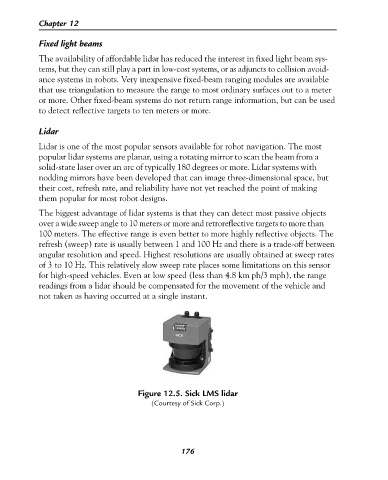
            Lidar is one of the most popular sensors available for robot navigation. The most
            popular lidar systems are planar, using a rotating mirror to scan the beam from a
            solid-state laser over an arc of typically 180 degrees or more. Lidar systems with
            nodding mirrors have been developed that can image three-dimensional space, but
            their cost, refresh rate, and reliability have not yet reached the point of making
            them popular for most robot designs.
            The biggest advantage of lidar systems is that they can detect most passive objects
            over a wide sweep angle to 10 meters or more and retroreflective targets to more than
            100 meters. The effective range is even better to more highly reflective objects. The
            refresh (sweep) rate is usually between 1 and 100 Hz and there is a trade-off between
            angular resolution and speed. Highest resolutions are usually obtained at sweep rates
            of 3 to 10 Hz. This relatively slow sweep rate places some limitations on this sensor
            for high-speed vehicles. Even at low speed (less than 4.8 km ph/3 mph), the range
            readings from a lidar should be compensated for the movement of the vehicle and
            not taken as having occurred at a single instant.


                                       Figure 12.5. Sick LMS lidar
                                           (Courtesy of Sick Corp.)


                                                   176

