


Page 118 - Designing Sociable Robots
P. 118
breazeal-79017  book  March 18, 2002  14:54


                       The Auditory System                                                   99


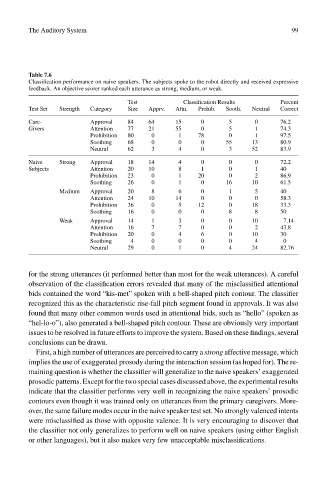
                       Table 7.6
                       Classification performance on naive speakers. The subjects spoke to the robot directly and received expressive
                       feedback. An objective scorer ranked each utterance as strong, medium, or weak.

                                                 Test           Classification Results     Percent
                       Test Set  Strength  Category  Size  Apprv.  Attn.  Prohib.  Sooth.  Neutral  Correct
                       Care-           Approval  84   64      15    0       5      0      76.2
                       Givers          Attention  77  21      55    0       5      1      74.3
                                       Prohibition  80  0     1     78      0      1      97.5
                                       Soothing  68    0      0     0      55     13      80.9
                                       Neutral   62    3      4     0       3     52      83.9

                       Naive   Strong  Approval  18   14      4     0       0      0      72.2
                       Subjects        Attention  20  10      8     1       0      1      40
                                       Prohibition  23  0     1     20      0      2      86.9
                                       Soothing  26    0      1     0      16     10      61.5
                               Medium  Approval  20    8      6     0       1      5      40
                                       Attention  24  10      14    0       0      0      58.3
                                       Prohibition  36  0     5     12      0     18      33.3
                                       Soothing  16    0      0     0       8      8      50
                               Weak    Approval  14    1      3     0       0     10      7.14
                                       Attention  16   7      7     0       0      2      43.8
                                       Prohibition  20  0     4     6       0     10      30
                                       Soothing   4    0      0     0       0      4      0
                                       Neutral   29    0      1     0       4     24      82.76


                       for the strong utterances (it performed better than most for the weak utterances). A careful
                       observation of the classification errors revealed that many of the misclassified attentional
                       bids contained the word “kis-met” spoken with a bell-shaped pitch contour. The classifier
                       recognized this as the characteristic rise-fall pitch segment found in approvals. It was also
                       found that many other common words used in attentional bids, such as “hello” (spoken as
                       “hel-lo-o”), also generated a bell-shaped pitch contour. These are obviously very important
                       issues to be resolved in future efforts to improve the system. Based on these findings, several
                       conclusions can be drawn.
                         First, a high number of utterances are perceived to carry a strong affective message, which
                       implies the use of exaggerated prosody during the interaction session (as hoped for). The re-
                       maining question is whether the classifier will generalize to the naive speakers’ exaggerated
                       prosodic patterns. Except for the two special cases discussed above, the experimental results
                       indicate that the classifier performs very well in recognizing the naive speakers’ prosodic
                       contours even though it was trained only on utterances from the primary caregivers. More-
                       over, the same failure modes occur in the naive speaker test set. No strongly valenced intents
                       were misclassified as those with opposite valence. It is very encouraging to discover that
                       the classifier not only generalizes to perform well on naive speakers (using either English
                       or other languages), but it also makes very few unacceptable misclassifications.

