


Page 114 - Designing Sociable Robots
P. 114
breazeal-79017  book  March 18, 2002  14:54


                       The Auditory System                                                   95


                                 Microphone
                                                                  Emotional
                                       acoustic                   Expression
                                       signal
                                  Low-Level                            net arousal,
                                 Speech Feature                        net valence,
                                                                       net stance
                                  Extraction                           of active emotion
                                       pitch,                   Emotion System
                                       energy
                                                                Emotion Arbitration
                            Affective Intent Recognizer
                                                              J  A  F  D  S  E
                              Prosodic Feature Extraction              elicitor
                                                                       contributions
                                                                 Emotion Elicitors
                                   Classifier
                                                              JE  AE  FE  DE  SE  EE
                                       neutral, approval,              affectively
                                        prohibition,                   tagged
                                       attention, comfort              perceptual
                                                                       contributions
                        Higher-Level Perceptual System
                         Emotional      Auditory   perceptual   Affective Assessment
                          Context,      Releasers  contribution
                                                                N    Pr   At
                        other Perceptual  At  Ap              [A, V, S]  [A, V, S]  [A, V, S]
                         Features,     N
                         Recognized      Pr  C                   Ap     C
                        Affective Intent                        [A, V, S]  [A, V, S]
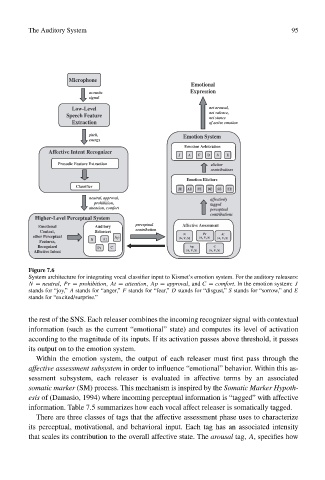
                       Figure 7.6
                       System architecture for integrating vocal classifier input to Kismet’s emotion system. For the auditory releasers:
                       N = neutral, Pr = prohibition, At = attention, Ap = approval, and C = comfort. In the emotion system: J
                       stands for “joy,” A stands for “anger,” F stands for “fear,” D stands for “disgust,” S stands for “sorrow,” and E
                       stands for “excited/surprise.”


                       the rest of the SNS. Each releaser combines the incoming recognizer signal with contextual
                       information (such as the current “emotional” state) and computes its level of activation
                       according to the magnitude of its inputs. If its activation passes above threshold, it passes
                       its output on to the emotion system.
                         Within the emotion system, the output of each releaser must first pass through the
                       affective assessment subsystem in order to influence “emotional” behavior. Within this as-
                       sessment subsystem, each releaser is evaluated in affective terms by an associated
                       somatic marker (SM) process. This mechanism is inspired by the Somatic Marker Hypoth-
                       esis of (Damasio, 1994) where incoming perceptual information is “tagged” with affective
                       information. Table 7.5 summarizes how each vocal affect releaser is somatically tagged.
                         There are three classes of tags that the affective assessment phase uses to characterize
                       its perceptual, motivational, and behavioral input. Each tag has an associated intensity
                       that scales its contribution to the overall affective state. The arousal tag, A, specifies how

