


Page 113 - Designing Sociable Robots
P. 113
breazeal-79017  book  March 18, 2002  14:54


                       94                                                               Chapter 7


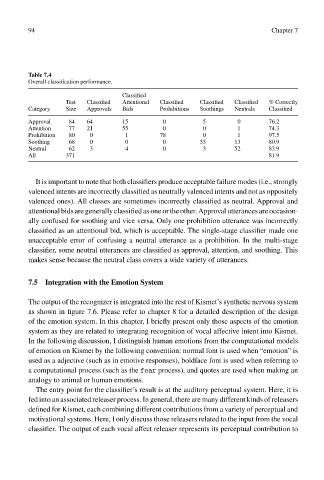
                       Table 7.4
                       Overall classification performance.
                                                Classified
                                 Test  Classified  Attentional  Classified  Classified  Classified  % Correctly
                       Category  Size  Approvals  Bids    Prohibitions  Soothings  Neutrals  Classified
                       Approval   84   64       15         0         5         0       76.2
                       Attention  77   21       55         0         0         1       74.3
                       Prohibition  80  0        1        78         0         1       97.5
                       Soothing   68   0         0         0         55       13       80.9
                       Neutral    62   3         4         0         3        52       83.9
                       All       371                                                   81.9


                         It is important to note that both classifiers produce acceptable failure modes (i.e., strongly
                       valenced intents are incorrectly classified as neutrally valenced intents and not as oppositely
                       valenced ones). All classes are sometimes incorrectly classified as neutral. Approval and
                       attentional bids are generally classified as one or the other. Approval utterances are occasion-
                       ally confused for soothing and vice versa. Only one prohibition utterance was incorrectly
                       classified as an attentional bid, which is acceptable. The single-stage classifier made one
                       unacceptable error of confusing a neutral utterance as a prohibition. In the multi-stage
                       classifier, some neutral utterances are classified as approval, attention, and soothing. This
                       makes sense because the neutral class covers a wide variety of utterances.

                       7.5  Integration with the Emotion System


                       The output of the recognizer is integrated into the rest of Kismet’s synthetic nervous system
                       as shown in figure 7.6. Please refer to chapter 8 for a detailed description of the design
                       of the emotion system. In this chapter, I briefly present only those aspects of the emotion
                       system as they are related to integrating recognition of vocal affective intent into Kismet.
                       In the following discussion, I distinguish human emotions from the computational models
                       of emotion on Kismet by the following convention: normal font is used when “emotion” is
                       used as a adjective (such as in emotive responses), boldface font is used when referring to
                       a computational process (such as the fear process), and quotes are used when making an
                       analogy to animal or human emotions.
                         The entry point for the classifier’s result is at the auditory perceptual system. Here, it is
                       fed into an associated releaser process. In general, there are many different kinds of releasers
                       defined for Kismet, each combining different contributions from a variety of perceptual and
                       motivational systems. Here, I only discuss those releasers related to the input from the vocal
                       classifier. The output of each vocal affect releaser represents its perceptual contribution to

