


Page 108 - Designing Sociable Robots
P. 108
breazeal-79017  book  March 18, 2002  14:54


                       The Auditory System                                                   89


                                You’re a clever robot  Very good  Good job yes  There you go
                                Pitch, f o (kHz)
                       Approvals


                                Hey Kismet over here  Kismet  Kismet look  Kismet you see that
                                Pitch, f o (kHz)
                       Attentional
                       Bids


                                  Bad robot  Kismet don’t do that   Stop it Kismet  No no no
                               Pitch, f o (kHz)
                       Prohibitions


                                  Ooh Kismet  It’s gonna be okay  Oh Kismet it’s okay  It’s okay
                                Pitch, f o (kHz)
                       Soothings


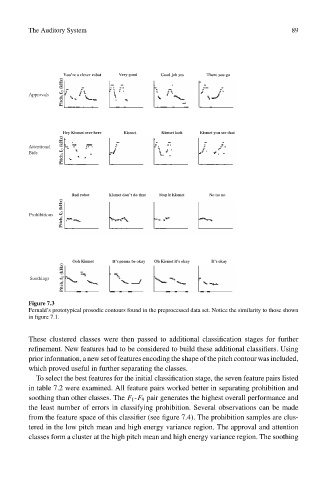
                       Figure 7.3
                       Fernald’s prototypical prosodic contours found in the preprocessed data set. Notice the similarity to those shown
                       in figure 7.1.


                       These clustered classes were then passed to additional classification stages for further
                       refinement. New features had to be considered to build these additional classifiers. Using
                       prior information, a new set of features encoding the shape of the pitch contour was included,
                       which proved useful in further separating the classes.
                         To select the best features for the initial classification stage, the seven feature pairs listed
                       in table 7.2 were examined. All feature pairs worked better in separating prohibition and
                       soothing than other classes. The F 1 -F 9 pair generates the highest overall performance and
                       the least number of errors in classifying prohibition. Several observations can be made
                       from the feature space of this classifier (see figure 7.4). The prohibition samples are clus-
                       tered in the low pitch mean and high energy variance region. The approval and attention
                       classes form a cluster at the high pitch mean and high energy variance region. The soothing

